Dự án FOIA của AIIA: Cập nhật thống kê kho hàng I-526E cho năm 2023
29th Tháng hai, 2024
AIIA trình bày phân tích dữ liệu chi tiết về ý nghĩa của dữ liệu FOIA mới này đối với các nhà đầu tư sau RIA. Hãy đọc blog của chúng tôi và tham gia webinar thảo luận về dữ liệu này trên YouTube để tìm hiểu thêm.
Bối cảnh:
As part of our mission to advocate for EB-5 investors, AIIA has filed multiple Freedom of Information Act (FOIA) requests for information from USCIS on topics that impact the EB-5 immigrant investor community. These have included:
- Information on staffing levels at the IPO, which affects the speed of processing EB-5 petitions
- Data for I-526/I-526E receipts by country and set-aside category, which is crucial for estimating the waiting times for incoming investors
- Administrative policies on I-829 processing criteria in order to assist investors in successfully getting their petitions approved and
- Implementation of the EB-5 Reform and Integrity Act of 2022.
Vì USCIS không thường xuyên cung cấp phản hồi kịp thời cho các yêu cầu theo Đạo luật Tự do Thông tin (FOIA), AIIA đã khởi kiện USCIS để buộc cơ quan này phải phản hồi. Chúng tôi đã nhận được và sẽ tiếp tục nhận được hàng trăm trang tài liệu, bao gồm các bản ghi nhớ nội bộ, email và tài liệu hướng dẫn đào tạo. Các thành viên AIIA có thể yêu cầu bản sao đầy đủ của các phản hồi từ chính phủ đối với các yêu cầu FOIA của AIIA. Nếu bạn muốn nhận bộ dữ liệu đầy đủ, vui lòng liên hệ với chúng tôi qua Biểu mẫu liên hệ.
Find this article too complex? Want even further specifics and predictions? Watch this webinar we did with some of the top EB-5 experts to further analyze the raw data and put forth possible wait time predictions on the different countries and visa categories.
AIIA was previously able to obtain data through April 2023 (reported here), and has now received a report through the end of 2023. The updated data contains the distribution of I-526 and I-526E receipts by TEA category and country of chargeability, which is crucial for understanding visa backlog and waiting time estimation in the new reserved visa categories. In this blog, we have analyzed the data to assess 1) economic impact of EB-5 in the post RIA world, 2) the trend in filings and 3) what the visa backlog/potential wait times could look like for investors.
In summary, the latest data indicates a moderate growth in demand for the Rural TEA category, but still below the needed level to absorb the near-term annual visa supply, including visas carried over from the previous year. Conversely, demand for visas in Urban High Unemployment TEAs remained high and is on track to surpass annual availability.
Xu hướng nhu cầu theo loại TEA
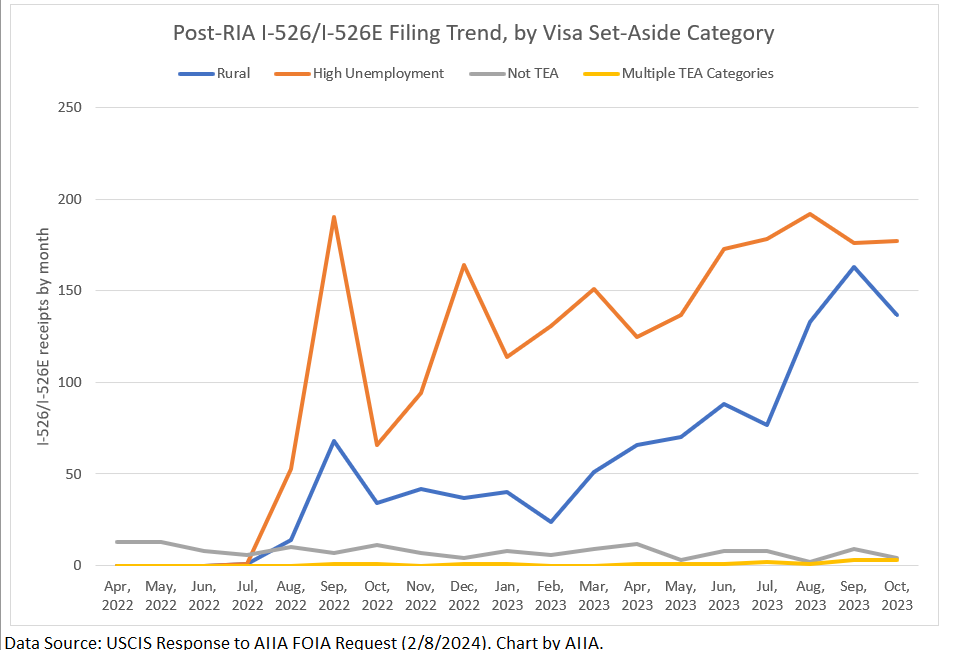
Compared to the data we have previously received, this new batch of data clearly shows a surge in the number of petitions in the rural category. The number of rural I-526E petitions saw a significant jump afterJuly 2023 and is now close to the high unemployment category in terms of monthly applications (see chart 1). While the ratio of total rural I-526Es compared to total high unemployment I-526Es have been steadily rising from April’s 1:3 to around 1:2 as of today, it should still be noted that the demand and supply of rural and high unemployment categories is still lopsided, considering that the ratio of rural to high unemployment visa supply is 2:1.
Xu hướng nhu cầu theo quốc gia
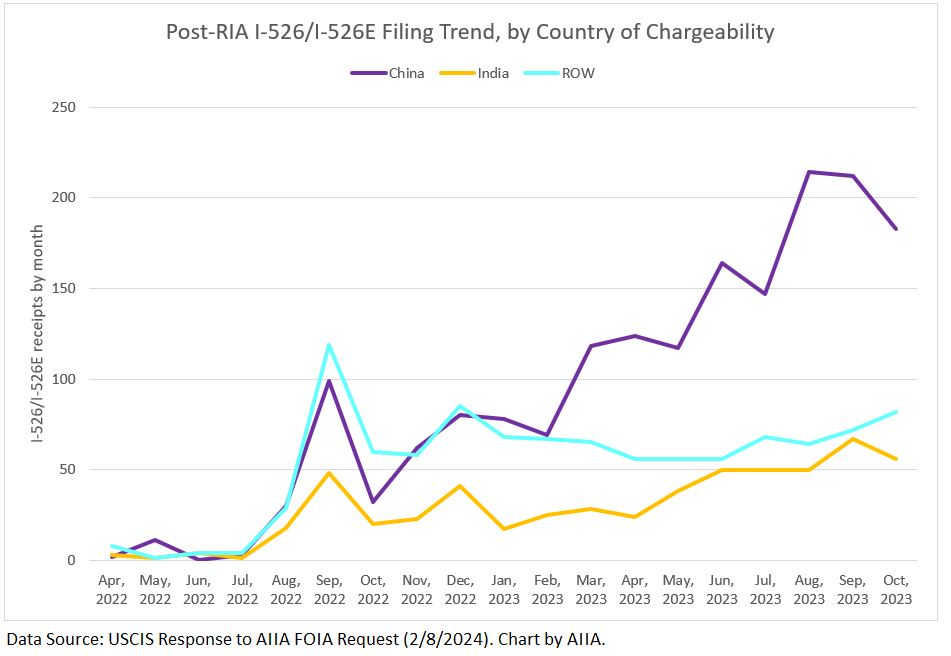
The data also shows demand from China increased, while that from India and other countries remained steady.
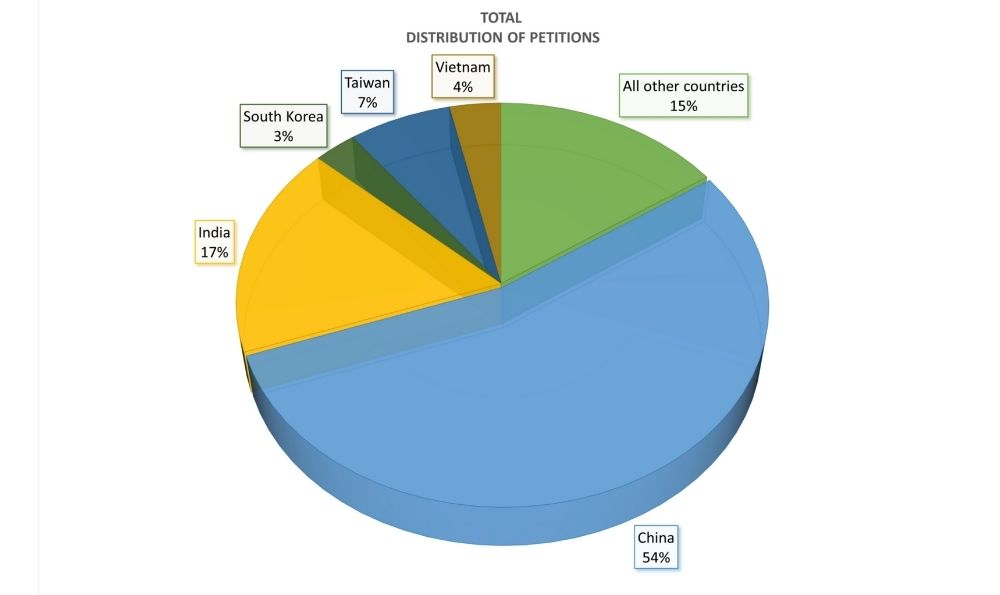
The table below shows the total number of I-526 and I-526E petitions filed after the enactment of RIA, including petitions for reserved visa categories. The key point to note is the high demand from the Rest of the World in the high unemployment category. This opens the potential for a visa backlog for the ROW investors and is also likely to affect the visa availability beyond the 7% country cap for investors from China and India.
Total number of I-526/I-526E filed from April 1, 2022 to November 2023, by TEA category and country of chargeability (latest stats as per our FOIA data)
| Trung Quốc | Ấn Độ | Đài Loan | Phần còn lại của thế giới | Tổng cộng | % Tổng cộng | |
| Nông thôn | 767 | 174 | 18 | 134 | 1,093 | 32% |
| Tỷ lệ thất nghiệp cao | 976 | 375 | 209 | 625 | 2,185 | 63% |
| Hạ tầng | 0% | |||||
| Multiple TEA Categories | 7 | 3 | 5 | 16 | 0.5% | |
| Not TEA | 26 | 21 | 6 | 97 | 150 | 4% |
| Tổng cộng | 1,776 | 573 | 233 | 861 | 3,444 | 100% |
| % Tổng cộng | 52% | 17% | 7% | 25% | 100% |
The pending inventory of I-526 and I-526E petitions represents an “invisible backlog” that is not reflected in the visa bulletin because they have not yet reached the visa stage. This backlog indicates the growing pipeline of people who will eventually apply for visas.
AIIA is doing its best to bring the invisible backlog out into the open. With this information, prospective investors can assess what they are getting into, pending applicants can see where they are in line, and responsible EB-5 investment issuers can protect their investors by advocating for visa relief. We believe the industry needs to band together and support any and all policies that make the inevitable backlog-induced wait times more tolerable.
While measures such as concurrent filing and decoupling sustainment of investment from the immigration timeline have helped mitigate concerns, visa relief remains crucial. The current visa numbers are insufficient to accommodate the investments made under the EB-5 program, highlighting the need for legislative action.
Congressional representatives should be delighted to hear that foreign EB-5 investors have already committed over $874 million into rural areas and $1.7 billion into distressed urban areas since the RIA was passed. A huge economic benefit attracted by the promise of a visa incentive! Congress should also realize that the current law under RIA only provides sufficient annual visas to actually deliver about $640 million in rural EB-5 investment and $320 million in high unemployment EB-5 investment annually.
Comparing Demand with Supply
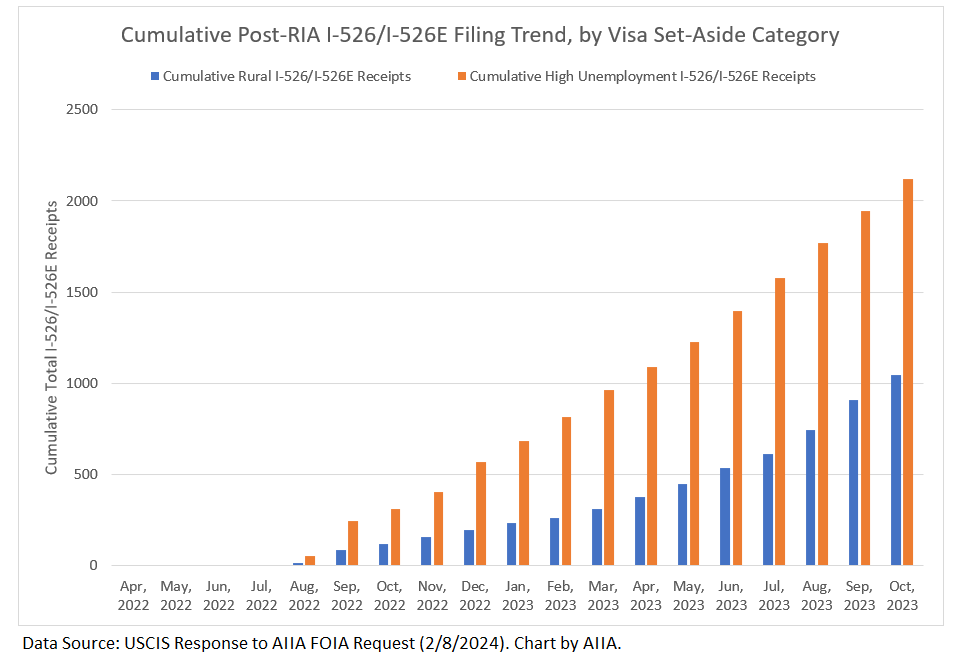
Based on the information we have, we can compare the demand pipeline with supply of visas and see whether a backlog is likely. To make the comparison, we first take the known number of I-526/I-526E receipts (each representing one investor) and convert that into an estimated number of future visa applicants (which includes investors plus spouses and children, less attrition from denials). We then compare pipeline visa applicants per category with visa supply per category in coming years. The demand/supply comparison shows that by the end of October 2023, cumulative pipeline visa demand significantly exceeded annual high unemployment visa availability, even in a year with extra carryover visas. Meanwhile, the rural demand pipeline appeared still below near-term visa supply, but high enough to absorb all available visas in a normal year.
Rural:

High Unemployment:
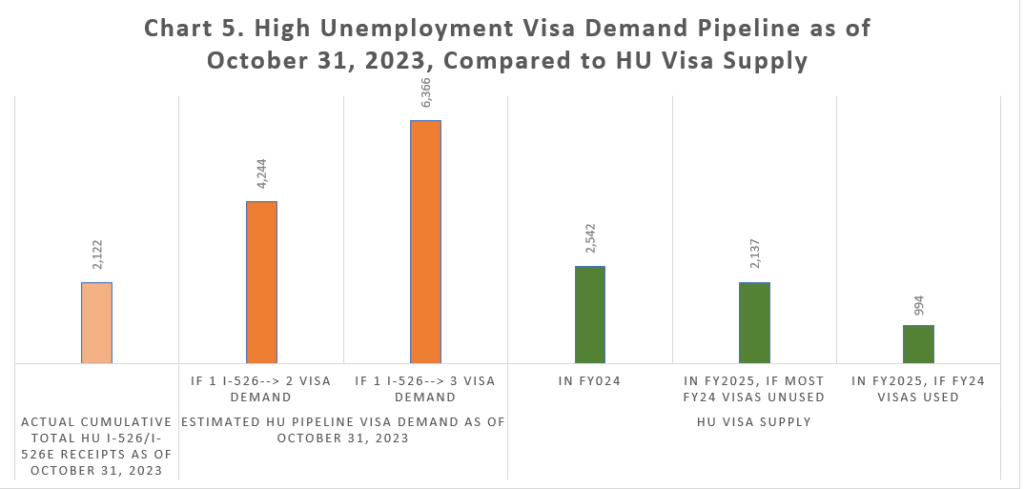
Please note:
*Actual cumulative I-526 and I-526E receipts from USCIS Response to AIIA FOIA Request (2/8/2024).
*Visa demand estimates multiply I-526/I-526E receipts by 2 or 3 (estimate considering addition of family and attrition from denials)
*Visa supply numbers are actual for FY2024; this supply can only be used as I-526s get approved in time.
*The first estimate for FY2025 assumes maximum possible carryover if FY24 visas unused; the second shows supply without carryover.
Thời gian chờ đợi để được cấp visa là bao lâu nếu tôi đầu tư ngay hôm nay?
Wait times result when visa demand exceeds limited annual visa supply. Estimating specific wait times starts with facts, including how many investors have already joined the queue for visas, how many visas will be available, and how visas get allocated by country and category. Then the estimate has to add assumptions on top of the facts, including assumptions about family sizes, future denial rates, and future I-526/I-526E processing speed, volumes, and priority. People with different agendas will use different assumptions and reach different conclusions. But it is critical for every estimate to at least start from facts. As an organization, AIIA will not tell you the one and only way to interpret the data, but we want to empower you with data to interpret for yourself. As we did with the April 2023 FOIA response, we also plan to host a webinar with industry experts explaining how they make wait-time estimates based on available information.
Individual wait time estimates are complex and open to difference of opinion, but the big picture is simple: demand > supply = wait times. By that metric, the high unemployment category was clearly already headed toward a significant backlog and visa wait times as of November 2023, the end of last year, while the rural category appeared to have some cushion but is approaching the backlog rapidly. Individual analysis should drill down more deeply and include the country factor. The backlog risk is especially a concern for applicants from China and India, considering that these countries have shown strong demand but are limited to 7% of available visas plus what is leftover from the rest of the world.
Những suy nghĩ cuối cùng
Nhà đầu tư và chuyên gia dựa vào dữ liệu chính xác để đưa ra quyết định có căn cứ về di trú và đầu tư cho khách hàng của họ. Việc hiểu rõ quy trình xử lý và thời gian cấp visa, cũng như số lượng nhà đầu tư đang chờ đợi, là yếu tố quan trọng trong Chương trình EB-5, đặc biệt trong bối cảnh chính sách di trú còn nhiều bất ổn. Tuy nhiên, USCIS không cung cấp thông tin này một cách nhất quán, dẫn đến việc AIIA nộp đơn yêu cầu theo Đạo luật Tự do Thông tin (FOIA) thay mặt cho cộng đồng EB-5.
As a nonprofit organization, AIIA invests significant time and resources in acquiring, analyzing, and disseminating this data. We rely solely on donations to sustain our efforts, including funding FOIA litigation, lobbying, and daily operations. We urge anyone who values our work to enhance transparency in the EB-5 program to consider supporting us by making a donation or membership contribution. Your support is vital in ensuring that we can continue to advocate for transparency and equity in the EB-5 program, benefiting investors and industry professionals alike.
Danh bạ các chuyên gia

AIIA đã tuyển chọn một danh sách các chuyên gia hàng đầu, bao gồm luật sư, chuyên gia đầu tư và người viết kế hoạch kinh doanh, để hỗ trợ tất cả các bên liên quan đến chương trình EB-5.
Xem Danh bạ Chuyên giaBài viết liên quan
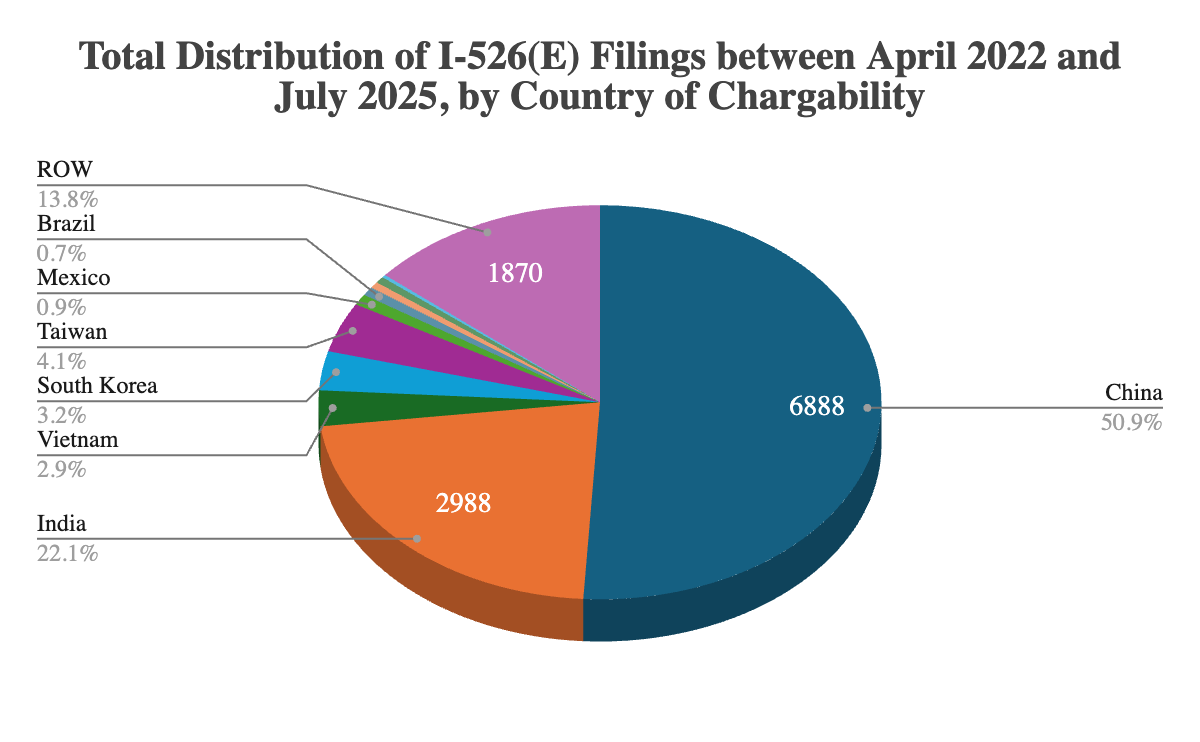
AIIA FOIA Series: Updated I-526E Inventory Statistics for July 2025
AIIA Submits Comments on USCIS NPRM on Updated EB-5 Fee Rule
Chúng tôi xin chúc mừng Thượng nghị sĩ Gallego về dự luật mới tận dụng Chương trình EB-5 để xây dựng nhà ở giá rẻ.

Chúng tôi đã thắng kiện vụ kiện về việc tăng phí EB-5.

Danh bạ các chuyên gia
AIIA đã tuyển chọn một danh sách các chuyên gia hàng đầu, bao gồm luật sư, chuyên gia đầu tư và người viết kế hoạch kinh doanh, để hỗ trợ tất cả các bên liên quan đến chương trình EB-5.
Xem Danh bạ Chuyên giaBài viết liên quan
AIIA FOIA Series: Updated I-526E Inventory Statistics for July 2025
AIIA Submits Comments on USCIS NPRM on Updated EB-5 Fee Rule
Chúng tôi xin chúc mừng Thượng nghị sĩ Gallego về dự luật mới tận dụng Chương trình EB-5 để xây dựng nhà ở giá rẻ.
Chúng tôi đã thắng kiện vụ kiện về việc tăng phí EB-5.

Cập nhật thông tin mới nhất từ AIIA
Đăng ký nhận bản tin của chúng tôi để cập nhật thông tin mới nhất về chương trình EB-5.
Bằng cách đăng ký, bạn đồng ý với Chính sách Bảo mật của chúng tôi và đồng ý nhận các cập nhật từ công ty chúng tôi.
Nguồn tài liệu được khuyến nghị

Vấn đề về việc hết hạn tuổi trong chương trình EB-5
Luật Bảo vệ Tuổi của Trẻ em (CSPA) giúp giữ nguyên tuổi của trẻ em trong các đơn xin visa EB-5, nhưng tình trạng ùn tắc visa kéo dài vẫn tiềm ẩn rủi ro...
Đọc thêm
Việc bán các đợt chào bán chứng khoán EB-5
Bán chứng khoán EB-5 thường sử dụng các quy định miễn trừ theo Quy định D (nhà đầu tư Mỹ) và Quy định S (nhà đầu tư nước ngoài) để tránh đăng ký với Ủy ban Chứng khoán và Giao dịch Hoa Kỳ (SEC) trong khi...
Đọc thêm
Lựa chọn giữa tài trợ EB-5 trực tiếp và thông qua Trung tâm Khu vực
Chương trình EB-5 trực tiếp dành cho các nhà đầu tư cá nhân tạo ra việc làm trực tiếp; Chương trình EB-5 Trung tâm Khu vực tập hợp nhiều nhà đầu tư, tính cả việc làm trực tiếp và gián tiếp cho...
Đọc thêmBài viết mới nhất trên blog
AIIA FOIA Series: Updated I-526E Inventory Statistics for July 2025
AIIA obtained new FOIA data through July 31, 2025 revealing how USCIS is actually processing EB-5 petitions, showing heavy prioritization...
Tìm hiểu thêmAIIA Submits Comments on USCIS NPRM on Updated EB-5 Fee Rule
AIIA submitted comments on USCIS’s October 2025 EB-5 fee NPRM supporting revised, lawful fee levels but urging refunds for overpaid...
Tìm hiểu thêmChúng tôi xin chúc mừng Thượng nghị sĩ Gallego về dự luật mới tận dụng Chương trình EB-5 để xây dựng nhà ở giá rẻ.
Dự luật EB-5 của Thượng nghị sĩ Gallego huy động vốn nước ngoài để xây dựng nhà ở giá rẻ. Sự hợp tác này đã củng cố mối quan hệ và uy tín của AIIA với Quốc hội...
Tìm hiểu thêmChúng tôi đã thắng kiện vụ kiện về việc tăng phí EB-5.
AIIA đã thắng kiện thành công trong vụ kiện chống lại việc tăng phí EB-5 của USCIS vào tháng 4 năm 2024, với phán quyết của một thẩm phán liên bang rằng cơ quan này...
Tìm hiểu thêmLiên hệ với chúng tôi
Nếu quý vị có bất kỳ câu hỏi, thắc mắc hoặc đề xuất hợp tác nào, xin vui lòng liên hệ với chúng tôi mà không ngần ngại.
 Vietnamese
  English
  Chinese
Phản hồi (0)