Class Action Lawsuit Filed Against USCIS for EB-5 Fee Refunds
25th Tháng năm, 2026
Did you pay inflated EB-5 filing fees after April 2024? AIIA has filed a federal class action lawsuit against USCIS to recover your money.

The American Immigrant Investor Alliance (AIIA) continues our work of advocacy on behalf of EB-5 immigrant investors. Most recently, AIIA scored a major legal victory by winning a lawsuit against U.S. Citizenship and Immigration Services (USCIS) regarding increases to filing fees for EB-5-related immigrant petitions and applications. USCIS in 2024 had unfairly, arbitrarily, and capriciously increased the fees for Forms I-526/I-526E, I-829, and I-956 by over 150 percent each. The increases were outrageous, and AIIA refused to let them go unchallenged. On Nov. 11, a United States District Judge ruled in our favor and restored the fees to their earlier amounts.
Now, because the fee increases were unlawful from the moment of their promulgation, AIIA is helping drive the initiative to sue the United States government to get back investors’ money. The underlying lawsuit did not seek a return of fees by USCIS, and they are unlikely to part with the overcharged funds willingly. Thus, we seek a return of excess fees, collected illegally, by USCIS from April 1, 2024 onwards. Our attorneys have filed a class action lawsuit against USCIS in federal court to obtain declaratory relief and have USCIS return the money to investors and regional center operators.
AIIA’s legal counsel — at The Galati Law Firm, and Wasden LLC — along with other plaintiffs, have filed the class action lawsuit in the United States District Court for the Western District of Washington.
Background to the Lawsuit
The EB-5 Reform and Integrity Act (RIA) of 2022 was passed by Congress to reauthorize and modify the EB-5 Immigrant Investor Program. Among its provisions, Congress required USCIS to complete an EB-5 fee study on or before March 15, 2023. USCIS was only permitted to change the petitioning/filing fees of the EB-5 program after completing this study.
Sadly, USCIS did not complete the required study by March 15, 2023. Yet, despite this failure, USCIS’s parent agency — the Department of Homeland Security — published a proposed regulation on January 31, 2024, that would raise the EB-5 program’s filing fees by exorbitant amounts.
As the aforementioned table shows, USCIS raised the I-526/I-526(E) filing fee by a whopping 204 percent, to $11,160. It also raised the I-829 filing fee by 154 percent, to $9,525. Taken together, an EB-5 investor would have to pay an extra $13,260 in filing fees to USCIS to complete the immigration process.
These fees impose great hardship. Contrary to popular misconceptions, most EB-5 investors are not ultra wealthy foreign nationals seeking to “buy” green cards. A large majority of EB-5 investors are members of the middle-class in their home countries. Their $800,000 investment into a regional center’s project is usually sourced from their life’s savings, the sale of their home, or borrowed from several relatives. These investors pursue the EB-5 process at great costs to themselves, in order to achieve a better life in America. The financial hardship of such a high investment — alongside legal fees to an EB-5 attorney, which can exceed $40,000, as well as other fees for currency conversion and escrow — is therefore severe.
Hence, USCIS’s dramatic increases in filing fees by hundred-percent figures without cause and without measurable improvements to its service quality were unacceptable to AIIA. They would increase the financial burden of the EB-5 process on many middle-class investors. Moreover, unlike the principal EB-5 investment, filing fees submitted to USCIS are non-refundable, which means that each investor would be losing an extra $13,260 on the process. For many prospective investors, the new cost was prohibitive, and this might lead them to choose to not pursue the EB-5 program.
The fee increases were, in fact, unreasonable. As aforementioned, USCIS was required by Congress to conduct a fee study before increasing any filing fees, which it failed to do. No new fee imposed without such a study is, therefore, reasonable.
Additionally, the Immigration and Nationality Act requires that filing fees be “set at a level that will ensure recovery of the full costs of providing all such services”. It also allows fees to include the costs of services “provided without charge to asylum applicants or other immigrants.” AIIA acknowledges that the dramatic increase in unauthorized immigration to the United States, and the massive backlog of asylum applications, may entail fee increases for EB-5 recipients that includes the costs of addressing this challenge. Nevertheless, it is unacceptable that EB-5 petitioners face 204 percent and 154 percent increases to their filing fees. By comparison, petitioners in other immigrant and non-immigrant classifications did not face such exorbitant fees. The burden of such fee increases fell, unfairly, on EB-5 petitioners.
Given these facts, AIIA could not accept the unfairness of the proposal for EB-5 investors. To that end, we filed a lawsuit against USCIS on March 19, 2024 to stop the new fee regulation from taking effect. We sought a temporary restraining order (TRO) to prevent USCIS from increasing the fees while litigation was underway. Sadly, the U.S. District Court for the District of Colorado, where we filed suit, refused our request for a TRO.
However, we won the lawsuit. In a November 11, 2025 decision, U.S. District Judge Charlotte Noelle Sweeney, ruled that USCIS had unlawfully increased the filing fees for EB-5 petitions and applications. Her order partly stayed (i.e., blocked) the fee increases, based on arguments on the merits. She found USCIS’s actions to be “arbitrary, capricious, and not in accordance with law,” pursuant to the Administrative Procedure Act (APA), as AIIA had argued in court.
Our Present Fight
After winning the first lawsuit in November to declare the fees illegal, AIIA’s legal team has filed a fresh lawsuit in federal court to recover the illegally-collected fees from USCIS, based on Judge Sweeney’s ruling.
This effort is a class action lawsuit, i.e., a special legal action where a few named plaintiffs represent a larger class of many unnamed plaintiffs, who were similarly harmed by USCIS’s actions. Currently, the suit has 62 named plaintiffs, representing a class that may comprise up to 8,000 affected investors.
New plaintiffs are eligible to join the class, provided they were EB-5 stakeholders who filed an I-526/I-526(E), I-829, or I-956G petition between April 1, 2024 and November 12, 2025. If you are an investor or regional center who filed such a form during these periods, please ensure your information was filled in correctly on this linked form.
Our legal team is arguing that USCIS’s unlawful collection of fees violates the Due Process Clause of the U.S. Constitution, and demanding that it return the difference between the original fees and the unlawfully-increased fees.
If successful, this lawsuit will require USCIS to refund all eligible investors and regional centers the difference between the illegally-imposed new fees and the original fees. Each investor and regional center stands to regain thousands of dollars each from such refunds.
We have put together an FAQ below for stakeholders.
Câu hỏi thường gặp
What is a class action lawsuit?
A “class action lawsuit” is a special type of civil lawsuit in the United States legal system, which allows a large number of people to join together and sue a particular entity — usually, a large corporation, wealthy individual, or the United States government.
In such a lawsuit, one plaintiff leads the case and represents the interests of many other plaintiffs, sometimes hundreds of thousands of other people. They are an ideal method of obtaining relief when one large entity’s misconduct has affected many entities, and individual lawsuits of the same subject matter would clog the judiciary.
In brief, for a class action lawsuit to proceed, the class in question must be “certified” — a number of plaintiffs must be recognized and ordained as a “class” by the U.S. District Judge presiding over the case. The criteria required for class certification are that the class must have:
Numerosity; i.e., be so numerous that having all plaintiffs appear individually in the suit is impractical (generally presumed when there are at least 40 plaintiffs);
Commonality; i.e., there must be questions of fact and law common to all members of the class;
Typicality; i.e., each of the defendants’ individual claims are of a kind that is regularly encountered in the class; and
Adequacy (of representation); i.e., the lead plaintiffs will fairly represent the interests of the whole class, and not just themselves.
Xem Fed. R. Civ. P. 23(a)(1)-(4).
Only once a class action lawsuit is certified may the case proceed with arguments on the merits and, eventually, a final disposition. Often, the mere fact of class certification is enough to force a big defendant to settle before trial, thereby avoiding potentially greater damages in a verdict, as civil juries are presumed to be sympathetic to plaintiffs in class action cases.
What are the legal fees and how much will participation cost me?
Class actions, due to the large award amounts, compensate attorneys by prior agreement to set aside some of the final award for legal costs and fees (i.e., a “contingency fee” arrangement). The exact amount of the trial/settlement award set aside for legal costs is determined by the presiding judge, though it is never more than 50 percent of the total amount. If the lawsuit fails, the attorneys involved usually do not get paid, though certain engagement agreements may have different terms.
In this class action, the Galati Law Firm LLC and Wasden LLC have proposed an engagement agreement that, in the event that the plaintiffs prevail, the firms shall seek a maximum of “one-third of the class-wide settlement amount.” This 33% is on the lower side of typical fees charged by class action attorneys.
Thereafter, the funds shall be apportioned to the plaintiffs pro-rata, i.e., proportional to their share of the sum total damages that the class has incurred.
This means that, by signing the engagement agreement and joining the class, plaintiffs will incur zero upfront costs. Any costs of litigation will be settled with the final judgement. However, for this reason, plaintiffs should know that they are unlikely to receive the full amount of the fees they were illegally charged by USCIS. They will receive only a share of that amount.
Has a case like this been filed before?
Yes. Class action lawsuits are filed very frequently in the United States upon various different issues. They are entirely within precedent. This class action, in form, is a very regular and anodyne lawsuit. A lawsuit on the subject of USCIS’s fee increases has not been filed before because the increase in 2024 was never so blatantly illegal. However, given that AIIA has prevailed on the previous lawsuit on the merits of the claim, it is highly likely that investors will obtain at least a settlement with USCIS to recover a substantial sum.
Will the U.S. government retaliate against me for participating in the lawsuit?
No. Lawsuits against the United States government usually never prejudice plaintiffs in unrelated proceedings before the government, such as immigration proceedings. USCIS case officers (who are career civil servants), particularly those in the Investor Program Office (IPO) that administers the EB-5 program, do not normally know of lawsuits filed by petitioners against the agency, which are handled by a different department. In any case, it would be highly illegal for USCIS to penalize a petitioner apropos their immigration process for engaging in legal action against the agency, as suing the government is not a negative criterion authorized to be considered in merit-based immigration proceedings or adjustments of status. Neither are such lawsuits a valid basis for USCIS to subject a petition or application to a Controlled Application Review and Resolution Process (i.e., “CARRP”), where the agency aggressively looks for a pretextual reason to deny a petition or application. Therefore, there’s no reason to expect any effect upon an investor’s EB-5 petitions and applications, adjustment of status, or applications for naturalization with this action.
Many investors may think that, while the rules may prevent retaliation, such retaliation is effectively possible due to informal networks in the agency and institutional loyalty. They may draw on lessons from their home countries, where governments behave in such a retaliatory manner against legal challengers. They should be assured that the United States is a country where such activity does not occur. Strict acontextual adherence to process, devoid of personal investment in an agency’s political priorities, is the hallmark of the U.S. bureaucracy. Any retaliation by the government against individual plaintiffs is highly unusual and unexpected.
How is this class action suit different from a Writ of Mandamus?
A writ of mandamus, in the United States, is a statutory law remedy available to plaintiffs seeking a court to order an agency to perform some legal duty in which it is failing. The law requiring such a duty is usually not at issue, and the court decides the matter in a bench proceeding as a matter of law, opposed to a full civil trial on the facts. In EB-5 proceedings, suits for writs of mandamus are commonly filed by investors seeking timely USCIS action on I-829 Petitions to Remove Conditions on Permanent Residence, which are supposed to be adjudicated by the time an investor completes two years of conditional Lawful Permanent Residency.
Writs of mandamus are not commonly used to compel agencies to pay funds to plaintiffs that have been wrongly obtained. This is because, unlike in cases involving writs of mandamus, the legal question of whether the agency must undertake a particular action (in this case, refund wrongfully collected fees) is still unanswered. The prior lawsuit that AIIA won regarding the fee increases turned on the limited question of whether the increase itself was unlawful, and not whether restitution was required. This means that the class action may involve a full civil trial on whether USCIS must repay the fees it wrongfully collected.
How much of a refund can I expect from USCIS on the fees I overpaid?
Before reading this answer, see the answer to Frequently Asked Question 2. It is impossible to determine, at this stage, how much each investor will receive. The total amount of money will depend on whether USCIS chooses to go to trial or negotiate a settlement. If the latter, the legal negotiations over the settlement may vary the exact amount. Thereafter, if a settlement is reached, our legal counsel will deduct their legal fees and costs as specified in the engagement letter.
How long will this case take?
It is impossible to determine how long the case will take. Given the numerosity of plaintiffs, the large sums involved, and the possibility of appeals on the underlying collateral proceeding (i.e., whether the fee increase was itself unlawful), we expect the class action’s legal proceedings to be exhaustive. It is our endeavor to get investors their money as quickly as possible, though they should be prepared for the case to last years.
How will I receive updates on this case?
We may organize group webinars where information may be generally shared about the case, and private webinars for plaintiffs to share and discuss information about our legal strategy. For more up to date information and speak with us personally about the case, please become an AIIA member.
What are the chances of winning this case?
We consider it highly likely that, on the merits, our attorneys will win this case and ensure a return of investor funds wrongfully collected. A federal court has already ruled that the imposition of the new and increased fees was unlawful. Therefore, the United States has no grounds to retain the funds so unlawfully collected. We do not anticipate jurisdictional issues and sovereign immunity concerns as affecting our case.
Who are the lawyers filing this case and what is their experience?
AIIA has retained two trusted immigration and litigation counsel for this lawsuit. We have worked with these attorneys previously, and we are assured of their expertise and diligence to press our claims to their maximum degree with zealous advocacy.
Matthew T. Galati is the principal attorney of The Galati Law Firm, PLLC. He is AIIA’s go-to counsel for Freedom of Information Act (FOIA) litigation against the U.S. government as part of our regulatory transparency initiatives. He is an experienced business immigration attorney, with his practice focusing on EB-5 petitions. He has litigated before dozens of federal district courts as well as the U.S. Department of Justice Executive Office of Immigration Review (EOIR). In 2022, the American Immigration Lawyers’ Association (AILA) conferred upon him the prestigious ‘Joseph Minsky Young Lawyer Award’ for outstanding contributions as a young lawyer to immigration and nationality law.
Jonathan Wasden is the principal of Wasden Immigration Litigation. He has extensive litigation experience as a U.S. government attorney. He served in the U.S. Department of Justice Civil Division’s Office of Immigration Litigation, in the trial section, where he practiced in U.S. District Courts across the country on a whole host of immigration-related cases, particularly challenges under the Administrative Procedure Act. He also worked in the U.S. Citizenship and Immigration Services Administrative Appeals Office (USCIS-AAO), where oversaw and ruled on appeals in EB-5 cases where investor petitions were denied or revoked. Mr. Wasden began his legal career as an active-duty military officer in the United States Air Force (USAF) Judge Advocate General (JAG) Corps, and has continued to serve for nearly 23 years. Presently, he is a Staff Judge Advocate officer in the Delaware Air National Guard, with the rank of Lieutenant Colonel. For the last ten years, Wasden has worked as a private practice immigration litigator. He handles complex immigration defenses including requests for evidence (RFE), notices of intent to deny (NOID), petition revocations, naturalization and denaturalization proceedings, and H-1B litigation.
Can I choose to work with alternate legal counsel and fight to get my fee refund on my own?
We strongly believe that we have put together the most favorable strategy and best lawyers to handle this case however we acknowledge that you may wish to choose to work with alternate counsel. Yes, you are more than welcome to not sign up for this suit and exclude yourself from the class when the time comes. Any eligible EB-5 stakeholder may work with alternative lawyers that are willing to sue the agency on your behalf to obtain a refund from the agency. You will be responsible for any costs associated with that litigation.
Conclusion
AIIA is pleased to be fighting on behalf of EB-5 investors, once again. We have a track record of putting together strong cases in federal court on behalf of EB-5 investors. Our victory in November to nullify the fee increases is proof. Now, we are taking the fight to USCIS, once again. The law is on our side, and we are confident that USCIS will return investors their money, whether by settlement in the case or through a trial and verdict on the merits. Victory is not guaranteed, but we are confident that our legal counsel will prevail in this case.
Litigation against the federal government is expensive. AIIA relies on donations from EB-5 stakeholders and pro-immigration supporters to continue its advocacy. If you believe we can help you, and support efforts to fight for immigrants’ rights in America, please contribute đến AIIA hoặc join our membership program Hôm nay.
Danh bạ các chuyên gia

AIIA đã tuyển chọn một danh sách các chuyên gia hàng đầu, bao gồm luật sư, chuyên gia đầu tư và người viết kế hoạch kinh doanh, để hỗ trợ tất cả các bên liên quan đến chương trình EB-5.
Xem Danh bạ Chuyên giaBài viết liên quan

Chúng tôi đã thắng kiện vụ kiện về việc tăng phí EB-5.

August 2025 Update on the Sustainment Period Lawsuit – What EB-5 Investors Need to Do

Cuộc chiến bảo vệ nhà đầu tư EB-5 thiện chí

IIUSA Fails to Come to An Agreement with USCIS on Sustainment Period

Danh bạ các chuyên gia
AIIA đã tuyển chọn một danh sách các chuyên gia hàng đầu, bao gồm luật sư, chuyên gia đầu tư và người viết kế hoạch kinh doanh, để hỗ trợ tất cả các bên liên quan đến chương trình EB-5.
Xem Danh bạ Chuyên giaBài viết liên quan
Chúng tôi đã thắng kiện vụ kiện về việc tăng phí EB-5.
August 2025 Update on the Sustainment Period Lawsuit – What EB-5 Investors Need to Do
Cuộc chiến bảo vệ nhà đầu tư EB-5 thiện chí
IIUSA Fails to Come to An Agreement with USCIS on Sustainment Period

Cập nhật thông tin mới nhất từ AIIA
Đăng ký nhận bản tin của chúng tôi để cập nhật thông tin mới nhất về chương trình EB-5.
Bằng cách đăng ký, bạn đồng ý với Chính sách Bảo mật của chúng tôi và đồng ý nhận các cập nhật từ công ty chúng tôi.
Nguồn tài liệu được khuyến nghị

Lệnh Mandamus (WOM) về việc xử lý chậm trễ hồ sơ EB-5
A Writ of Mandamus compels USCIS to act on delayed EB-5 petitions, but requires legal expertise and offers no guarantee...
Đọc thêmBài viết mới nhất trên blog
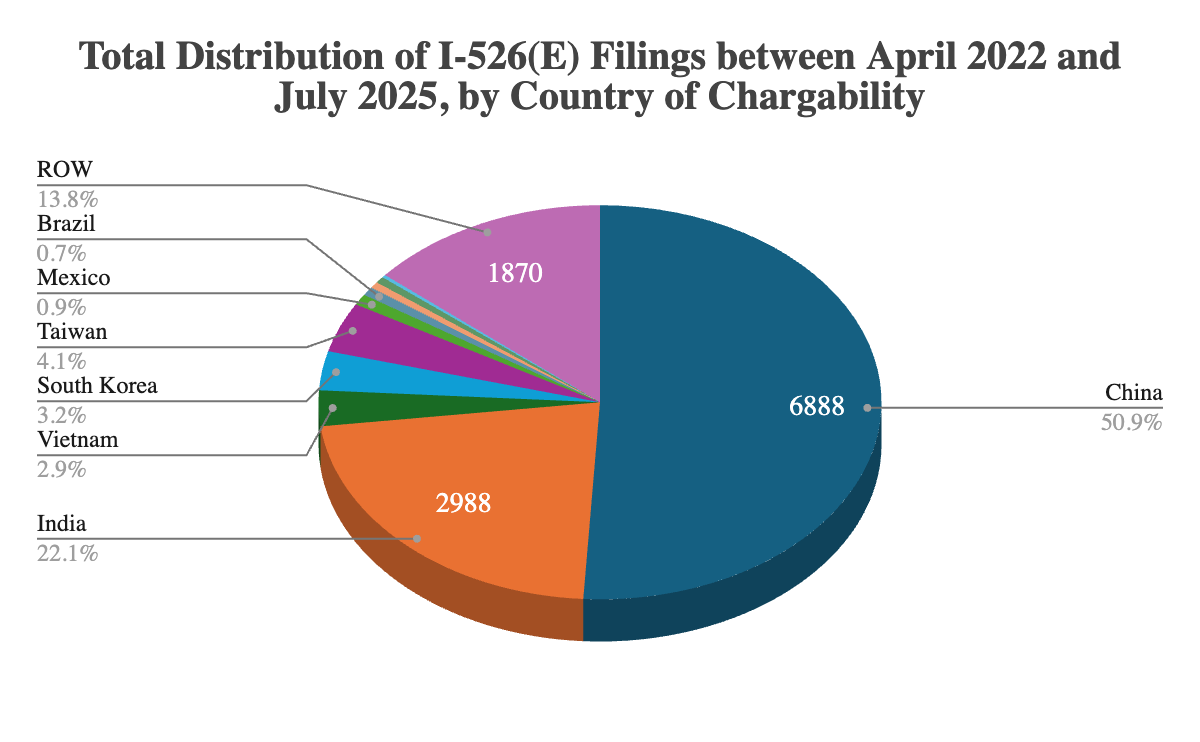
Chuỗi bài viết về Đạo luật Tự do Thông tin (FOIA) của AIIA: Số liệu thống kê cập nhật về hồ sơ I-526E tháng 7 năm 2025
AIIA đã thu thập được dữ liệu mới theo Đạo luật Tự do Thông tin (FOIA) tính đến ngày 31 tháng 7 năm 2025, tiết lộ cách USCIS thực sự xử lý các đơn xin EB-5, cho thấy việc ưu tiên xử lý rất cao...
Tìm hiểu thêm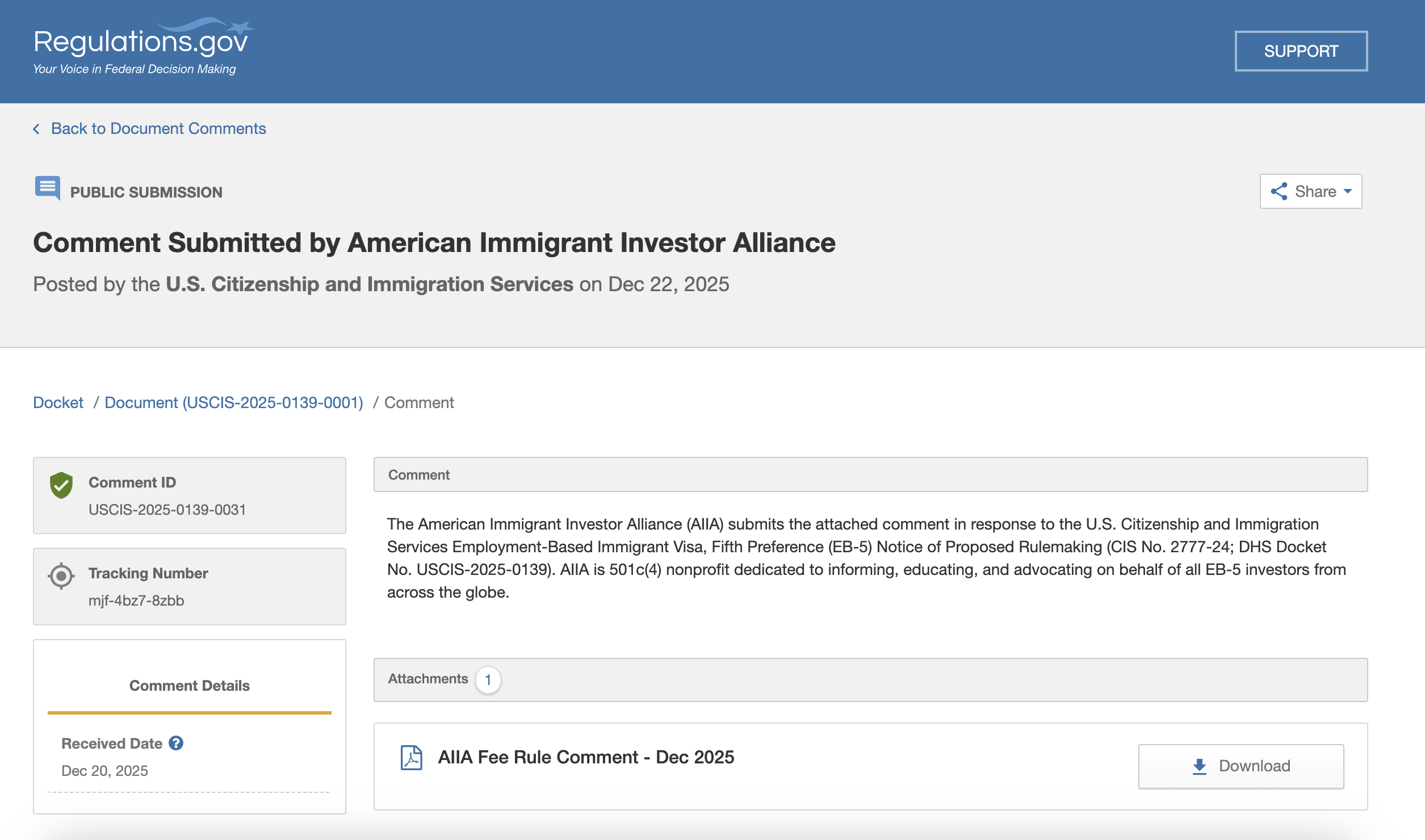
Hiệp hội Đầu tư Nước ngoài Hoa Kỳ (AIIA) gửi ý kiến đóng góp về Dự thảo Quy định (NPRM) của Sở Di trú và Nhập tịch Hoa Kỳ (USCIS) liên quan đến quy định cập nhật về lệ phí EB-5
AIIA đã gửi ý kiến đóng góp về Dự thảo Quy định về Phí EB-5 tháng 10 năm 2025 của USCIS, trong đó ủng hộ mức phí được điều chỉnh và hợp pháp, nhưng đồng thời kêu gọi hoàn trả số tiền đã nộp thừa...
Tìm hiểu thêm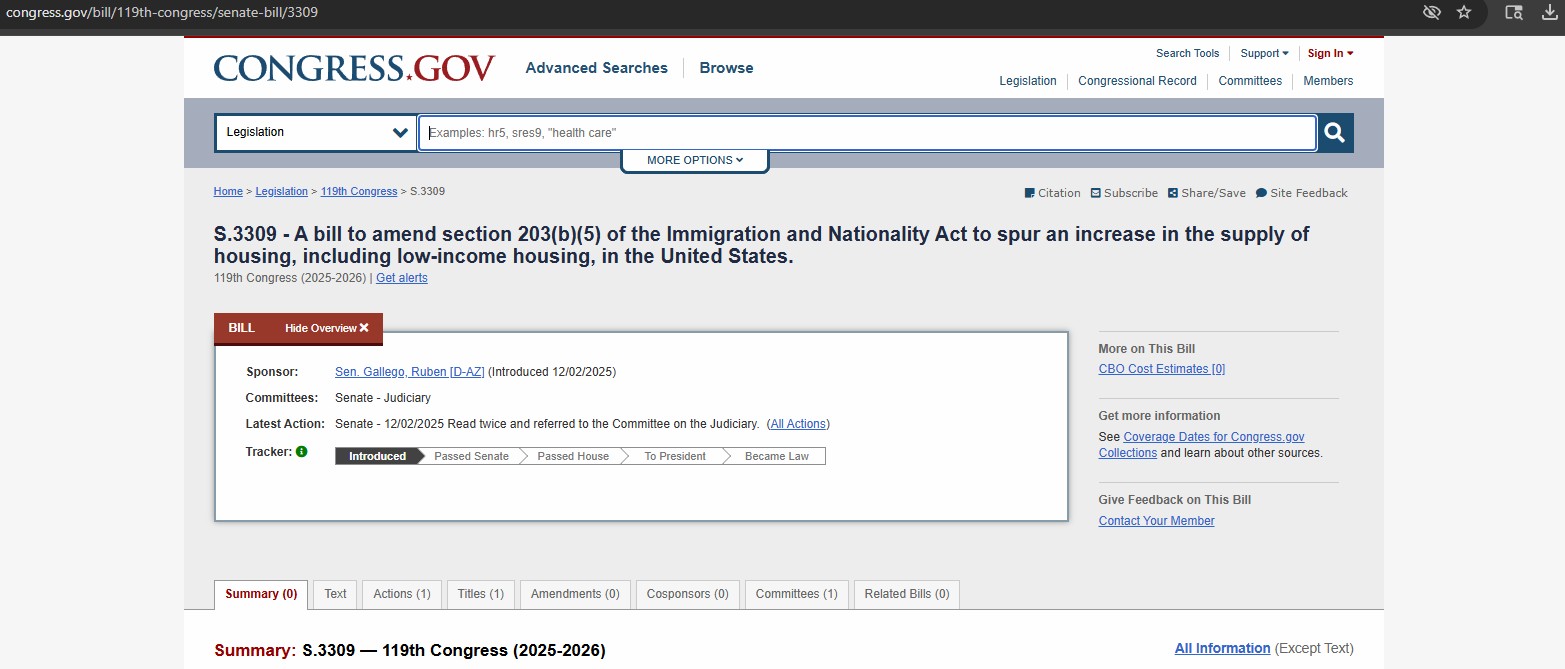
Chúng tôi xin chúc mừng Thượng nghị sĩ Gallego về dự luật mới tận dụng Chương trình EB-5 để xây dựng nhà ở giá rẻ.
Dự luật EB-5 của Thượng nghị sĩ Gallego huy động vốn nước ngoài để xây dựng nhà ở giá rẻ. Sự hợp tác này đã củng cố mối quan hệ và uy tín của AIIA với Quốc hội...
Tìm hiểu thêmChúng tôi đã thắng kiện vụ kiện về việc tăng phí EB-5.
AIIA đã thắng kiện thành công trong vụ kiện chống lại việc tăng phí EB-5 của USCIS vào tháng 4 năm 2024, với phán quyết của một thẩm phán liên bang rằng cơ quan này...
Tìm hiểu thêmLiên hệ với chúng tôi
Nếu quý vị có bất kỳ câu hỏi, thắc mắc hoặc đề xuất hợp tác nào, xin vui lòng liên hệ với chúng tôi mà không ngần ngại.
 Vietnamese
  English
  Chinese
Phản hồi (0)