AIIA FOIA Series: Updated I-526E Inventory Statistics for May 2026
23rd September, 2026
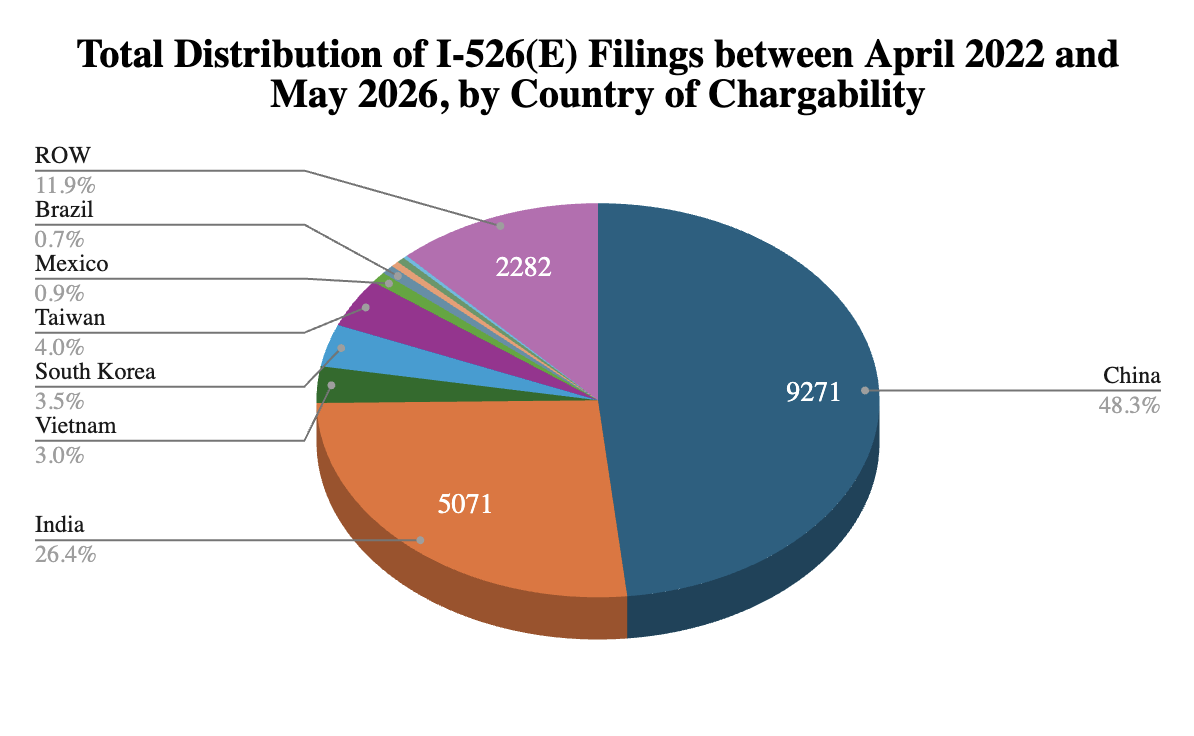
Investors from India and China still face significant visa backlogs regardless of category, Korea, Taiwan and Vietnam are still investing in HUA projects over rural.
Don’t want to read the full analysis? Just want answers to the question “How long do I have to wait for until I get my Immigrant Visa (aka conditional green card)?” Scroll to the end of the article for the section dedicated to that. Don’t forget to support our work.
Once again, AIIA has more information to share about what’s happening with backlogs and processing in all post-RIA EB-5 categories. Just this September, USCIS responded to our FOIA request for detail on I-526 and I-526E receipts, approvals, and denials by country, TEA category, and filing date through May 31, 2026. AIIA is grateful to Alexandra George of the Galati Law Firm for leading the FOIA litigation effort against USCIS in order to obtain this data.
As usual, the agency did not hand over the relevant data without a fight. As soon as the lawsuit for the data we used for this blog concluded, we had to immediately file yet another one for the next batch of data. As a nonprofit, we severely lack the funds to continue our valuable work without the support from the investor community. Obtaining this data and analyzing this costs us significant resources, and we ask that if you find our work useful and important in your decision making process, please consider becoming a member or donating to us. If you are unable to donate, you can help us by telling fellow investors and industry stakeholders to sign up for our mailing list.
Transparency for the EB-5 community should be an important prerogative for every stakeholder in the EB-5 space.
Our latest FOIA data through May 31, 2026 is crucial because it tells us how USCIS was processing the I-526E inventory in 2025 and 2026– which priority dates, TEA categories, and countries were getting approvals and denials, and which were left pending.
The data provided by USCIS to AIIA is the most complete post-RIA I-526(E) report to date because (1) the report provides receipts by month, which is important for showing trends, and (2) the report provides data that USCIS queried recently, in July 2026. The query date is important, because USCIS takes time to enter receipts into the database. The report that USCIS provided to AIIA states that 19,179 petitions (i.e., I-526 and I-526E) were filed in total between April 2022 and May 2026.
Problems in USCIS’s Data Collection Process
USCIS’s data set continues to show that there are no I-526E petitions or adjudications coming from the Infrastructure category, despite well-documented evidence to the contrary from other sources that we have already addressed in our previous FOIA blog. AIIA and our legal counsel are actively communicating with the agency to see if such omissions in their data collection process can be avoided in their future data releases.
May 2026 FOIA Data and Analysis
AIIA’s May 2026 FOIA request sought a report of all I-526 and I-526E Immigrant Petitions filed with USCIS, per month, from April 1, 2022 to May 31, 2026, further itemized by visa set aside category and by country for ten countries and the rest of the world. We also requested a report of all I-526 and I-526E approvals and denials for the same dates, countries, and categories. The following list, tables, and charts compile and analyze the data provided by USCIS. (AIIA Members may request a full copy of government responses to AIIA FOIA requests by reaching out to us through our contact form.)
Total number of I-526/I-526E petitions filed between April 1, 2022 and May 31, 2026 by TEA category and country of chargeability
| HUA | Rural | Infrastructure | Others | Total | %Total | |
| China | 3681 | 5270 | 0 | 320 | 9271 | 48.34% |
| India | 1949 | 2791 | 0 | 331 | 5071 | 26.44% |
| Vietnam | 367 | 163 | 0 | 42 | 572 | 2.98% |
| South Korea | 436 | 75 | 0 | 156 | 667 | 3.48% |
| Taiwan | 684 | 70 | 0 | 17 | 771 | 4.02% |
| ROW (Rest of World) | 1488 | 979 | 0 | 360 | 2827 | 14.74% |
| Total | 8605 | 9348 | 0 | 1226 | 19179 | 100% |
| %Total | 44.87% | 48.74% | 0% | 6.39% | 100% |
This above chart displays two firsts in the post-RIA world:
1) The sum of post-RIA petitions from Mainland China has dropped below 50% of all post-RIA EB-5 petitions across the world, reflecting a gradually cooling Chinese market while petitions from the second largest EB-5 market–India remains robust (between August 2025 and May 2026 there were only 2,383 new I-526/E petitions from Mainland China compared to 2,083 new petitions from India).
2) Total petitions in the Rural category have surpassed that of the High Unemployment category for the first time. This is potentially the downstream effect of the EB-5 community learning of the discrepancies between the adjudication speeds of these two categories.
Meanwhile, the charts below reflect the adjudication (including both approval and denial) data of those same petitions:
I-526/I-526E petitions adjudicated (approvals+denials) as of May 31, 2026 by TEA category and country of chargeability
| HUA | Rural | Infrastructure | Others | Total | %Total | |
| China | 555 | 2794 | 65 | 3414 | 47.21% | |
| India | 519 | 1647 | 69 | 2235 | 30.90% | |
| Vietnam | 90 | 100 | 10 | 200 | 2.77% | |
| South Korea | 102 | 38 | 108 | 248 | 3.43% | |
| Taiwan | 173 | 49 | 5 | 227 | 3.14% | |
| ROW (Rest of World) | 251 | 573 | 84 | 908 | 12.56% | |
| Total | 1690 | 5201 | 341 | 7232 | 100% | |
| %Total | 23.37% | 71.92% | 4.72% | 100% |
Total I-526/I-526E Receipts, Approvals, and Denials as of May 31, 2026, by TEA
| High Unemployment Area | Rural Area | Rural Area and HUA | Infrastructure | Unreserved & Unknown | Total | |
| Receipts | 8605 | 9348 | 471 | 0 | 755 | 19179 |
| Approvals | 1354 | 4763 | 77 | 0 | 155 | 6349 |
| Denials | 336 | 438 | 15 | 0 | 94 | 883 |
| Total Adjudicated | 1690 | 5201 | 92 | 0 | 249 | 7232 |
| Adjudications / Receipts | 20% | 56% | 20% | 0 | 33% | 38% |
I-526/I-526E Denial Rate by Country for petitions Adjudicated as of May 31, 2026
| Approvals April 2022 – May 2026 | Denials April 2022 – May 2026 | Denials % Total Processed | |
| China | 3013 | 401 | 12% |
| India | 1982 | 253 | 11% |
| Vietnam | 172 | 28 | 14% |
| South Korea | 206 | 42 | 17% |
| Taiwan | 211 | 16 | 7% |
| Rest of World | 765 | 143 | 16% |
| Grand Total | 6349 | 883 | 12% |
Demand Trend by TEA Category
Global Post-RIA I-526/I-526E Filing Trends, by Visa Set-Aside Categories
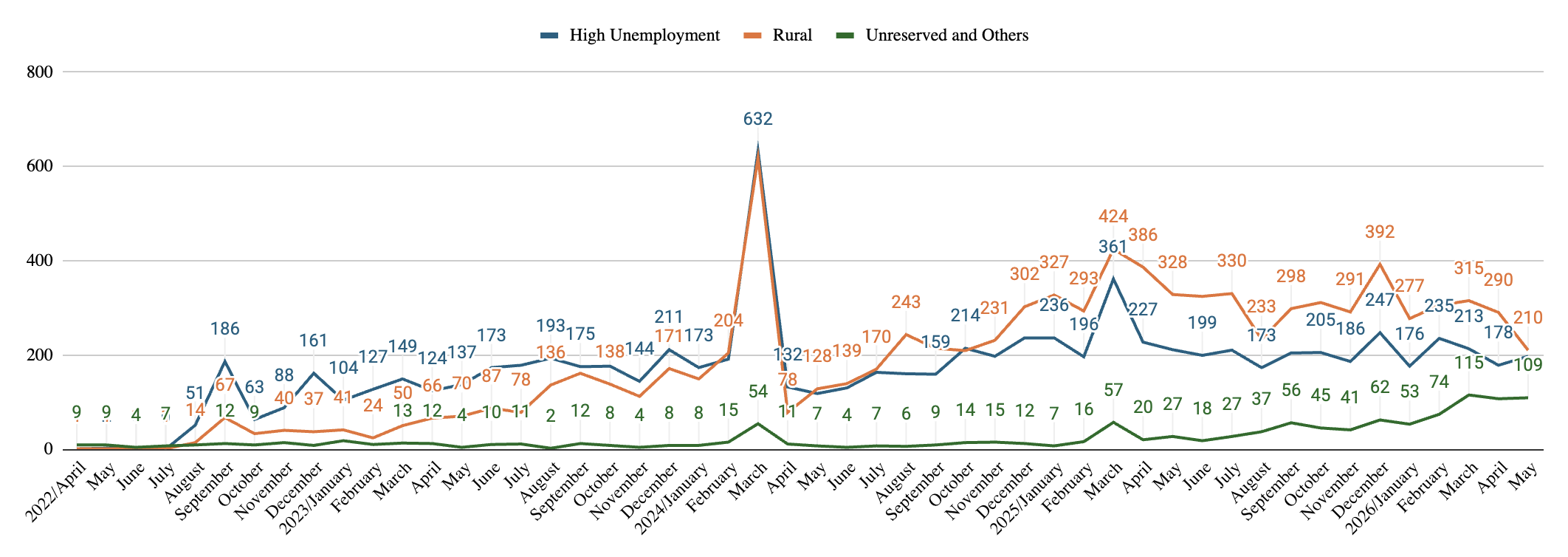 Rural vs High Unemployment I-526/I-526E Filings from Mainland China
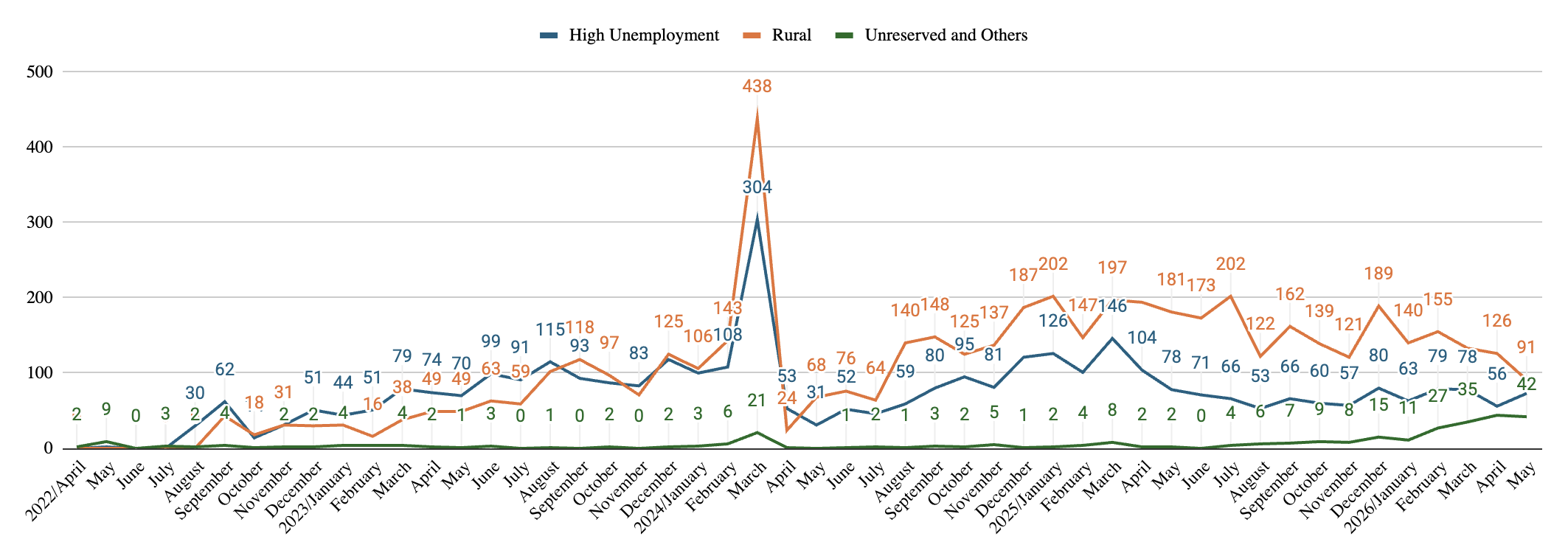
Rural vs High Unemployment I-526/I-526E Filings from India
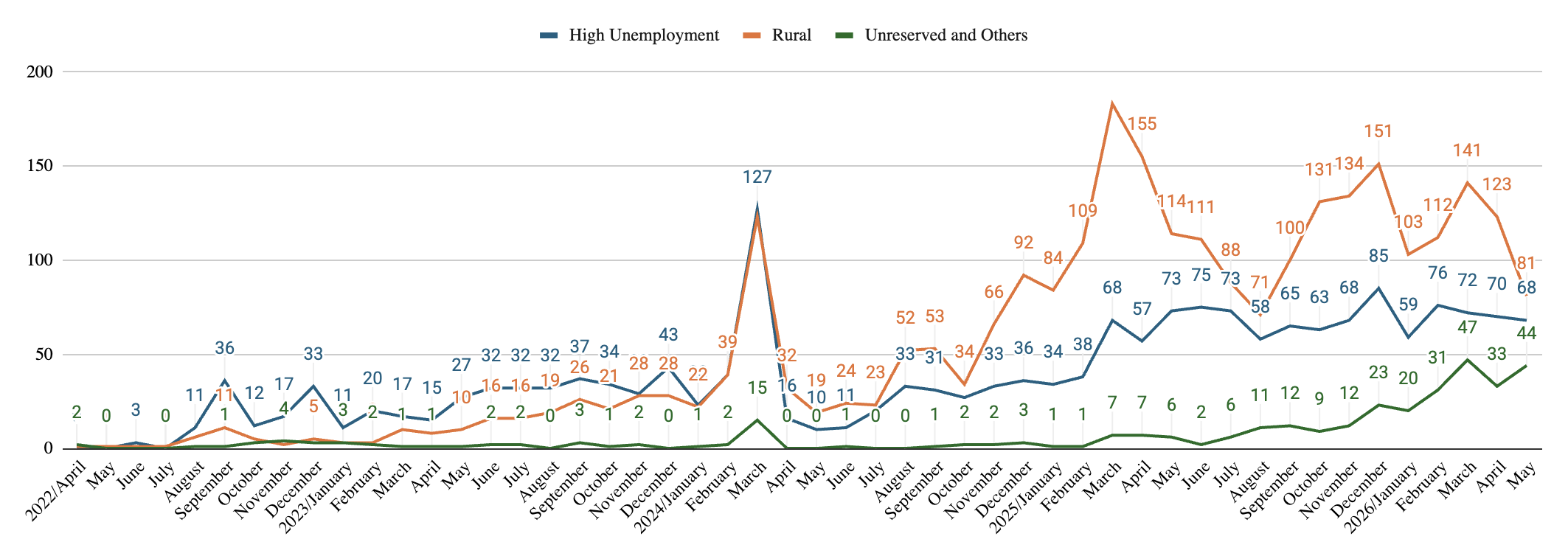
Rural vs High Unemployment I-526/I-526E Filings from Vietnam
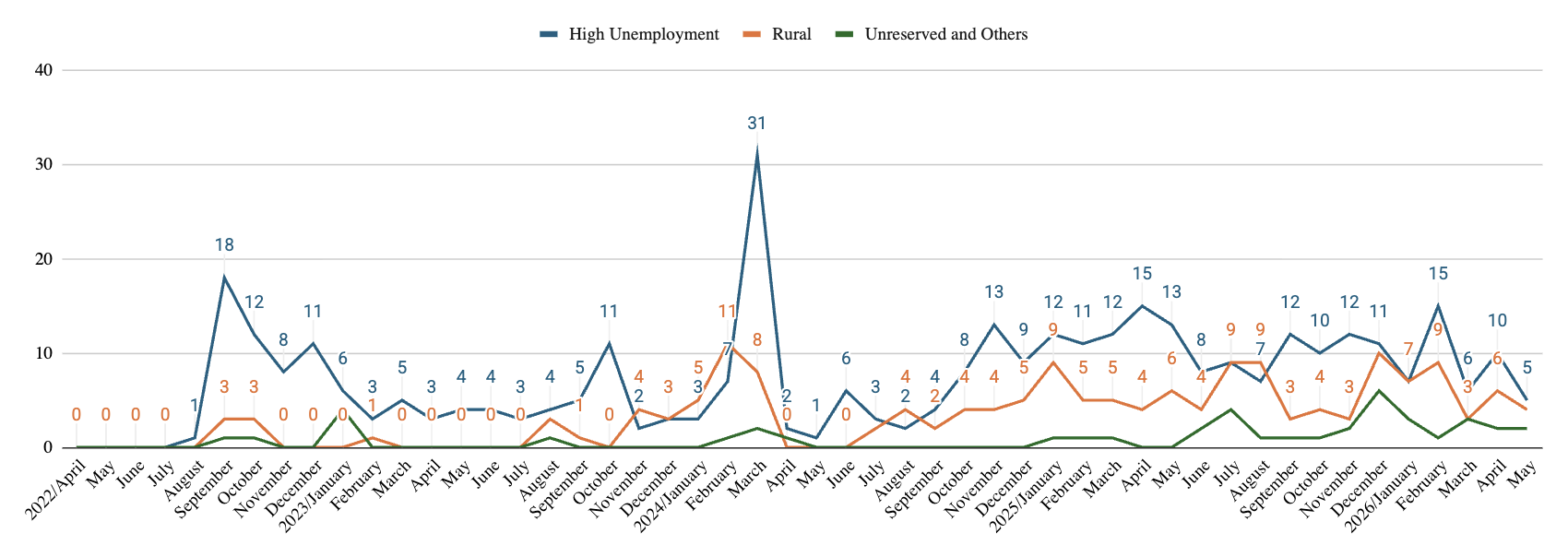
Rural vs High Unemployment I-526/I-526E Filings from South Korea
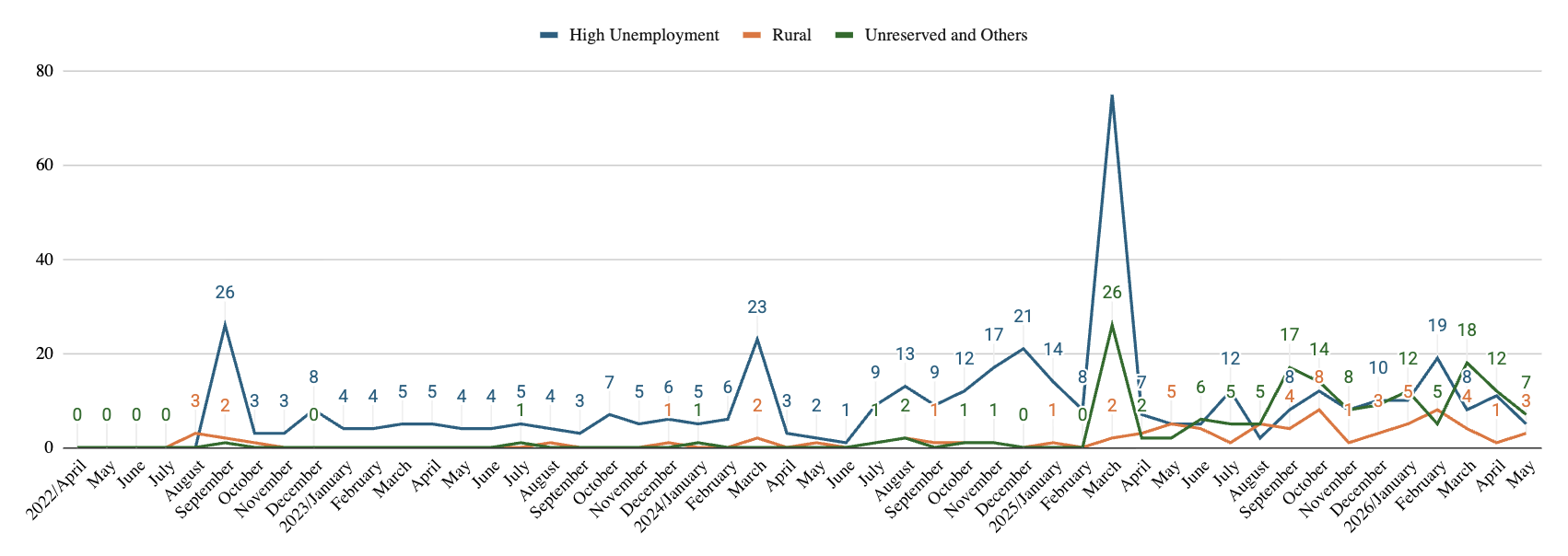
Rural vs High Unemployment I-526/I-526E Filings from Taiwan

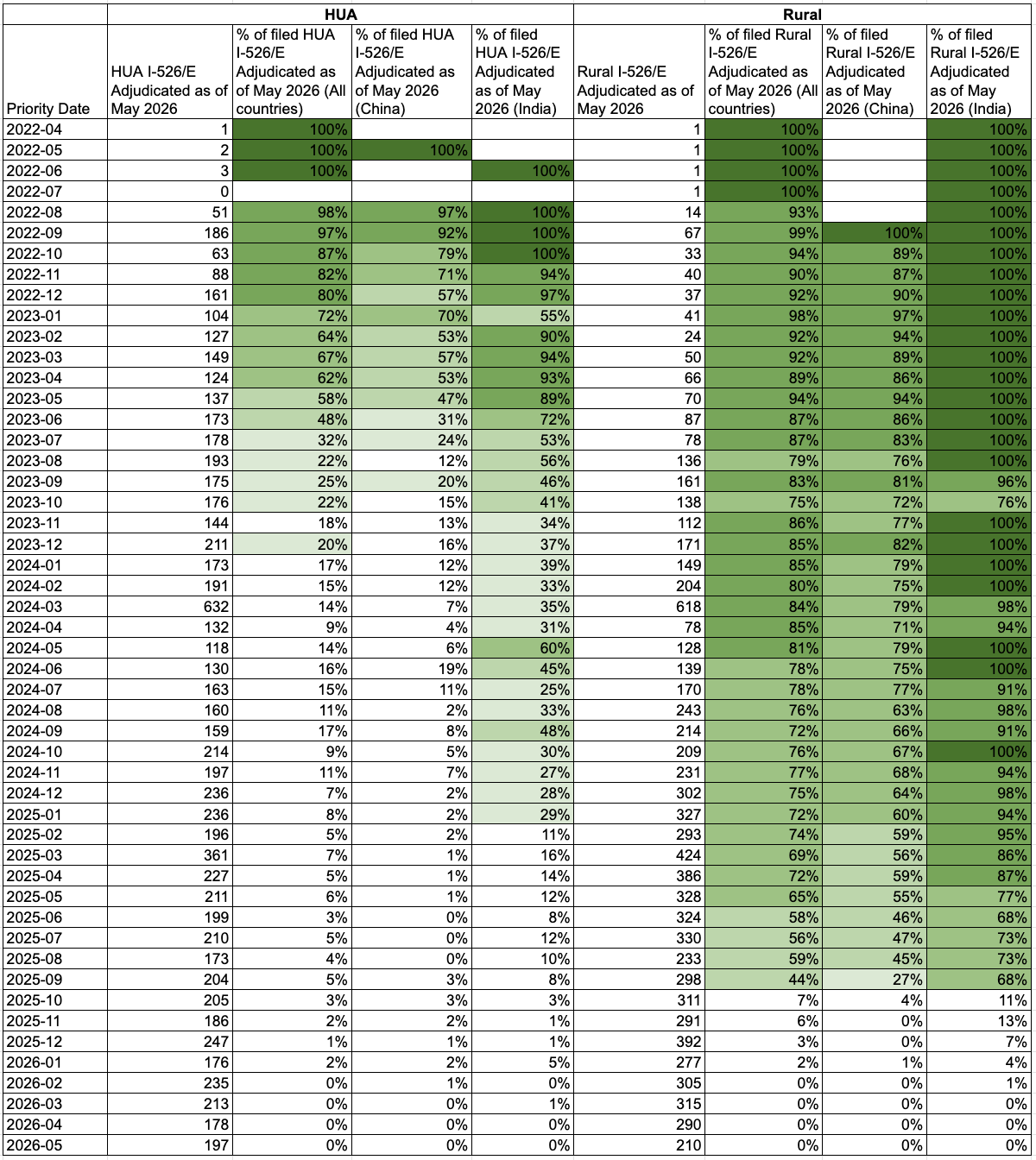
Comparing the percentage of filed I-526/E Adjudicated as of May 2026 (India, China and All countries)
Putting all this data together we can get a better understanding of how USCIS is prioritizing adjudication across the set aside categories and across countries.
Of the three major issues AIIA has identified in our last analysis, USCIS seems to have also recognized them and is working on them with varying degrees of success.
1) Slow adjudication speed for High Unemployment (HUA) and differing approval rate: As we have pointed out in our analysis of the July 2025 dataset, I-526E adjudications from the HUA category took up only 16% of all adjudications (which meant that only 8% of the HUA I-526Es were adjudicated compared to Rural’s 45% adjudication rate). This issue has been somewhat improved throughout the last year, as we compared the previous dataset with this one we found, more than 30% of adjudications between July 2025 and May 2026 to be HUA petitions.
One caveat of this positive development is that this boost in efficiency is accompanied by a noticeable increase in HUA cases being denied as well. HUA I-526Es only have a 80% approval rate, compared to the 92% approval rate from Rural (when such a large discrepancy was nowhere to be found in the July 2025 data).
2) Unfair distribution of adjudications between countries: As noted in our previous article, USCIS is adjudicating Indian born petitioners at a higher rate compared to Chinese, especially in the HUA category. It appears USCIS has taken concrete steps to course correct on that: in the past year they adjudicated more than double the HUA petitions from China than from India.
3) Non First in First Out (FIFO) adjudication order: USCIS has been retroactively working on earlier I-526E petitions, especially under the rural category, so that some of these early petitions are no longer left in limbo while later petitions are adjudicated (see chart below). However, the issue of non-FIFO adjudication order is still quite visible under the HUA category, which AIIA implores the agency to address as well.
Estimating Wait Times For Green Card
Everytime we release this data we get a flurry of follow up questions and ‘experts’ will attempt to analyze and opine on the potential wait times for prospective investors. We realize that a significant number of investors from all over the world invested between June and September, 2026 (right after the end of our dataset coverage).
While we cannot say firmly how long the wait time for a person from X country investing in Y category could be, here are some hard truths we want to share for prospective investors. This is our opinion and should not be construed as legal advice:
- If you are an investor born in any country other than India or China, you are a ROW (Rest of World) investor, your wait time to reach the conditional green card stage is purely dependent on how quickly the government moves to adjudicate your petition and issue you your immigrant visa.
- If you are born in India or China, no matter which set aside category you invest in, there is a visa backlog to face. How big is this backlog? This blog post contains those facts. How long will it take for the backlog to move? Hard to say, but if anyone claims that an investor from those countries investing today will have their conditional green card “within 2-3 years” is incorrect.
- The denial rates for post RIA investors is significantly lower than Pre-RIA investors. While this is good news for investors and fundraisers, this means a higher number of visa numbers will go to people in line for the EB-5 green card.
Looking Ahead
With the expiration of the grandfathering clause in the RIA coming up at the end of the month and the EB-5 Regional Center Program facing yet another reauthorization hurdle just a year away, it’s likely that the EB-5 program will have a tumultuous year ahead of us. Regardless of what happens next, AIIA will continue to champion for greater degrees of data and policy transparency on behalf of the entire EB-5 community.
As a nonprofit organization, AIIA invests significant time and resources in acquiring, analyzing, and disseminating this data. We rely solely on donations to sustain our efforts, including funding FOIA litigation, lobbying, and daily operations. We urge anyone who values our work to enhance transparency in the EB-5 program to consider supporting us by making a donation or membership contribution. Your support is vital in ensuring that we can continue to advocate for transparency and equity in the EB-5 program, benefiting investors and industry professionals alike.
Full Video Analysis with Expert Opinions
Watch on YouTube:
Directory of Professionals

AIIA has curated a list of the top professionals from attorneys, investment specialists, to business plan writers to support all EB-5 stakeholders.
View Directory of Professionals

Directory of Professionals
AIIA has curated a list of the top professionals from attorneys, investment specialists, to business plan writers to support all EB-5 stakeholders.
View Directory of Professionals
Stay Up To Date With AIIA
Join our newsletter to stay up to date on EB-5 updates.
By subscribing you agree to with our Privacy Policy and provide consent to receive updates from our company.
Recommended Resources

The Issue of Aging Out in EB-5
The Child Status Protection Act (CSPA) helps freeze a child’s age on EB-5 petitions, but long visa backlogs still risk...
Read More
Is EB-5 Regional Center Financing Right for My Project?
EB-5 regional center financing fits large projects creating many jobs, preferably in TEAs, with sufficient funds and investor appeal, but...
Read More
Timeline of EB-5 Regional Center Project Raise
EB-5 Regional Center capital raises typically take 2-3 years for approval, marketing, and fundraising, while investor green card processing may...
Read MoreRecent Blog Posts

The Administration is Attacking EB-5 by Wasting Visa Numbers through an RFE Debacle
USCIS is deliberately issuing baseless, repetitive RFEs demanding already-submitted Form I-693 medical exams from EB-5 and other employment-based adjustment applicants,...
Learn More
Investor First: Our Comment On The New Proposed EB-5 Rules
Our comments supporting the two-year sustainment clock while pressing for investor safeguards on third-party promoter liability, source-of-funds burdens, bridge financing,...
Learn More
Class Action Lawsuit Filed Against USCIS for EB-5 Fee Refunds
Did you pay inflated EB-5 filing fees after April 2024? AIIA has filed a federal class action lawsuit against USCIS...
Learn More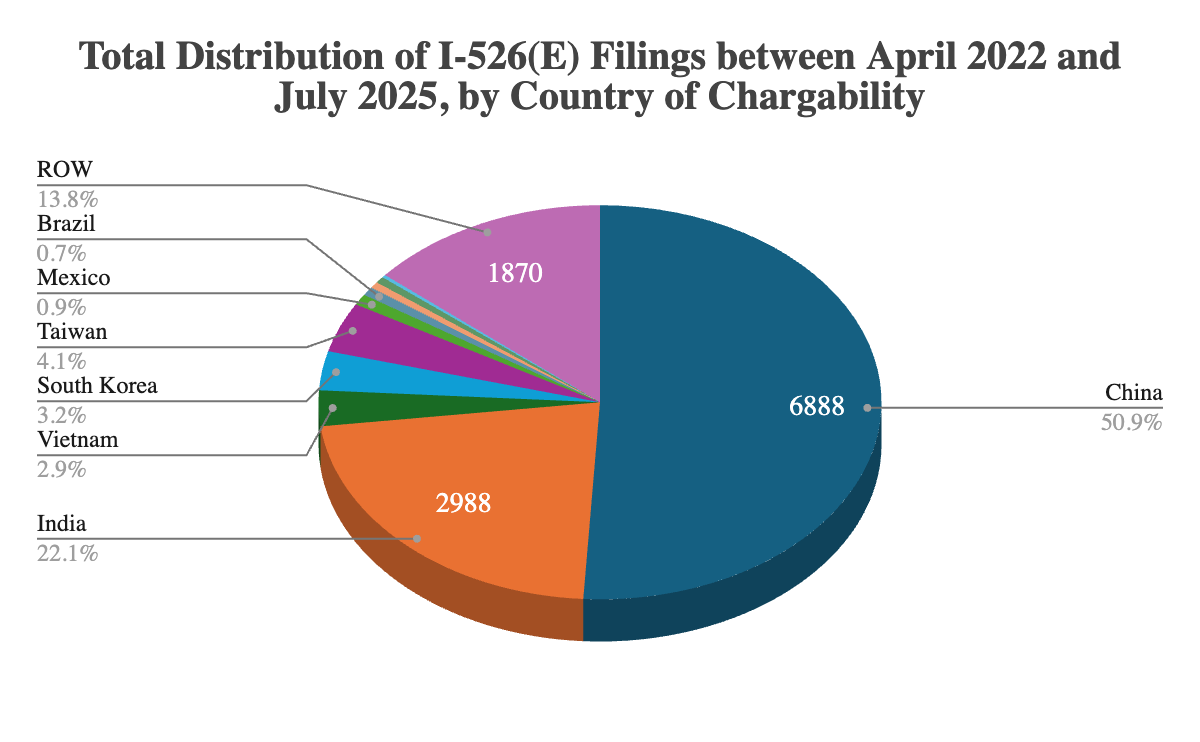
AIIA FOIA Series: Updated I-526E Inventory Statistics for July 2025
AIIA obtained new FOIA data through July 31, 2025 revealing how USCIS is actually processing EB-5 petitions, showing heavy prioritization...
Learn MoreGet In Touch With Us
If you have any questions, inquiries, or collaboration proposals, please don’t hesitate to reach out to us.
 English
  Chinese
  Vietnamese
Responses (0)