美国投资移民协会与公民和移民服务监察员(CISOMB)的第二次会议涉及的议题包括维持期、老龄化、资金来源和路径问题,以及 EB-5 投资者在申请受理和裁决方面的透明度。.
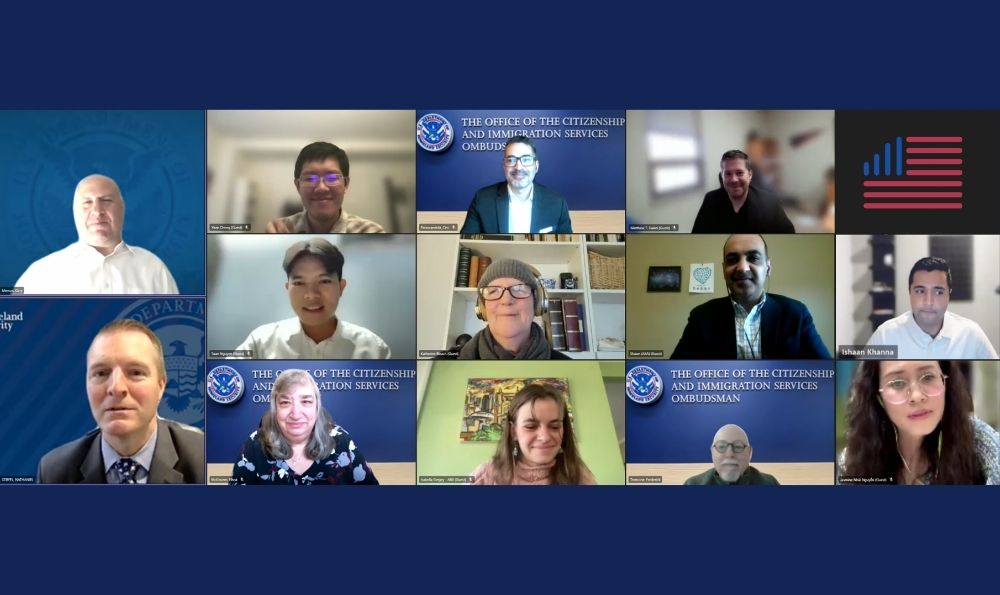
Last week, staff and supporters of the American Immigrant Investor Alliance (AIIA) met with the Citizenship and Immigrant Services Ombudsman’s Office (CISOMB) to hold our second round of discussion regarding improvements to the EB-5 program. This is the second meeting between AIIA and the CISOMB office and we were grateful to be joined by some of our strongest supporters.
Joining our advisory board and staff was Jasmine Nhài Nguyễn 和 Tuấn Nguyễn, co-founders of Loyalpass EB-5 Consultants, an agency which works with hundreds of investors from Vietnam and hosted AIIA in Vietnam last year. Additionally we were joined by a distinguished member of the EB-5 community, Katherine Bleach, an EB-5 investor from the UK who also joined us on our trip to Washington, D.C. to meet with Congressional offices in 2021.
Here are the topics we covered on our call:
1. Sustainment Period
The sustainment period update from USCIS in October was a huge step forward for the EB-5 investor community. Back in February of this year, AIIA had expressed to USCIS the importance of clarifying the sustainment period rules in favor of investors who faced arduously long immigration wait times and subsequent reinvestment of their capital. The issue of USCIS’s sustainment and redeployment policy has long been the thorn in every single EB-5 investor’s side. This trend has become especially harmful since 2015, when USCIS conceived the arbitrary policy concerning “at risk” requirements and wrongfully coupled the investment period to the immigration process. In turn, this policy became directly responsible for the malady of redeployment that has haunted EB-5 investors ever since.
In our previous meeting with the CIS Ombudsman in October, we stressed this point to the CISOMB team and they acted upon it – following up with USCIS which led to the agency releasing an updated policy regulation on Oct 11th, just one week after our meeting with the CISOMB. In the policy release, USCIS redefined its interpretation of the sustainment period for post-RIA investors (who invested after March 2022), stating that so long as the job-creation requirements were met, an EB-5 immigrant needed to sustain their investment for a minimum of only two years.
The subsequent USCIS EB-5 Engagement call with IPO chief, Alissa Emmel, and CISOMB officer, Gary Merson, clarified and reaffirmed the post-RIA investors’ rights to a two-year sustainment period as outlined in the RIA. The discussion on this call also acknowledged the harm caused to pre-RIA investors (who invested before March 2022), and implied that the IPO was open to resolutions to the unforeseen conflict of the pre-RIA sustainment period.
We took this opportunity to express our gratitude to the CISOMB office for their work in urging USCIS to take action on this matter, and the quick turnaround between our meeting and the sustainment period update. We expressed our gratitude on behalf of the EB-5 investor community for taking action on such a contentious matter and actually getting officials from USCIS to publicly admit that the extended sustainment period faced by pre-RIA investors from countries with long backlogs is not in line with the program’s vision when it was initially codified into law.
2. Informal Internal Standards regarding Adjudication and Re-Adjudication of Source of Funds/Path of Funds documentation
For 30 years, EB-5 stakeholders have used third party exchangers and currency swaps to facilitate legal investments in the U.S. and gain approvals on their legal path of funds. Yet recently, attorneys across the EB-5 industry have reported to us the many arbitrary denials on investor’s petitions taking place related to the use of “third party exchangers” or “currency swaps”. Additionally, source and path of funds are routinely being reexamined by IPO adjudicators at the I-829 stage, forgoing deference to I-526 adjudications on the same source and path of funds.
The Loyalpass team was able to elaborate on the arbitrary denials received by a plurality of investors in the Vietnamese EB-5 market. Loyalpass focused specifically on the currency controls in Vietnam; common methods of LEGAL fund transfers; denial trends related to currency swaps, especially since 2022; and the lack of any public information regarding the adjudication standards and forms of recourse for investors and professionals alike.
The Ombudsman’s office was highly receptive to the issues presented and asked for further details on denial trends and unclear policy standards. We hope the Ombudsman’s office will encourage the agency to provide clear guidance regarding evidence of lawful transfer of funds and legal avenues to invest outside currency controlled economies..
3. Processing capacity at IPO
Fiscal year 2024 will be the last year that any residual visa carryovers from the program lapse, the COVID pandemic, AND the set aside categories will be available to both the set aside and unreserved categories. It is a massive amount of visas, as shown on our post-RIA visa supply webinar.
If USCIS does not make an effort to process and transfer as many I-526/526Es as possible before September, the visa backlogs will naturally grow much longer, as the available carryover visa supply will be dramatically reduced.This is why restoring the IPO’s processing capacity to its 2018 peak is so critical.
However, although increasing the speed of processing is key, there are various simple processes that merely need to be reformed, such as unnecessary multi-month delays in digitally transferring approved I-526s to the National Visa Center. AIIA member Katherine Bleach helped bring attention to the lack of clarity regarding prioritization of reserved and unreserved petitions, as well as the “visa availability approach” for adjudication.
Additionally, Katherine was able to impress upon the CISOMB the extreme harm caused by processing delays to EB-5 investors, especially those that invested before March 2022. Stunted family, life, and financial planning are often factors of the immigration process that cannot be fully understood by administrators on the other side of the EB-5 program. Which is why we also discussed another critical topic:
4. CSPA Aging Out
The Child Status Protection Act (CSPA) is an immigration benefit which allows for children under the age of 21 to retain eligibility on their parent’s immigrant petition. Put simply, a child’s age is “frozen” on the date the I-526 is filed. Once it is approved, the age is unfrozen up until the DS-260 invitation is issued to an investor. If an approved I-526 is not sent to NVC for over a year, the child could age out before the main petitioners can even be issued a fee bill. The delay in sending these documents has huge implications for individual investors who risk family separation and are disincentivized from using the program because of this risk.
We also highlighted the inconsistencies in the interpretation of CSPA rules between different governmental agencies, especially when it comes to “visa availability”. The Department of State and USCIS have separate and incompatible interpretations of what constitutes “visa availability”. We made it clear that AIIA favors USCIS’s current interpretation of visa availability, because it offers immigrants a greater opportunity to protect their children listed on their immigration petition.
5. Transparency with EB-5 Stakeholders
The lack of clarity regarding unadjudicated post-RIA Forms I-526 and I-526E is of major concern for immigrant investors. Immigration attorneys and EB-5 investors alike cannot make sound decisions about the EB-5 immigration process and how to navigate it if they do not know how many other immigrants are waiting for visas in each EB-5 visa category. These invisible backlogs, which can last years, can be mitigated if USCIS publicly published data on their petition inventories and processing.
During the engagement between the IPO and the CISOMB, Merson prompted Emmel to discuss inventory and data reporting from the IPO. It was stated that the IPO was struggling with how to report data in a “useful way”. Yet, we urged the CISOMB to promote ANY type of data reporting at the IPO, regardless of analysis, human error, or approximations. EB-5 investors need to know the trends in filing and adjudications to make decisions about their immigration, investment, and future. As long as all caveats to the data’s accuracy are included in the release, the EB-5 community will benefit from having a loose interpretation of what to expect, rather than having no idea at all.
The full meeting agenda
AIIA is grateful to the CISOMB team for meeting with our partners to learn more about how the EB-5 program can grow and become more efficient and equitable. We strive to continue this beneficial relationship, not only on behalf of the EB-5 investors who make up our community, but also for the American people who have benefitted so greatly from this immigration program.
AIIA’s full meeting agenda and our notes from the call are available for review to our members. We discussed in depth all the issues discussed above and more, and will continue to work with the CISOMB to fix those with the most devastating impacts on EB-5 investors across the globe. If you have any comments, questions, or suggestions for our next meeting, please let us know! Send us a contact form submission and we will make sure to incorporate as many relevant points as possible into our next meeting agenda.
To support our work advocating for EB-5 investors, please consider making a donation to our cause, 成为会员 for exclusive access to AIIA content, or volunteering with us to grow our community. All contributions to our organization 的确 help us in executing our advocacy campaigns.


发表评论
答复 (2)

了解 AIIA 的最新动态
加入我们的时事通讯,了解 EB-5 的最新动态。.
一旦订阅,即表示您同意我们的隐私政策,并同意接收本公司的更新信息。
推荐资源



最近的博客文章
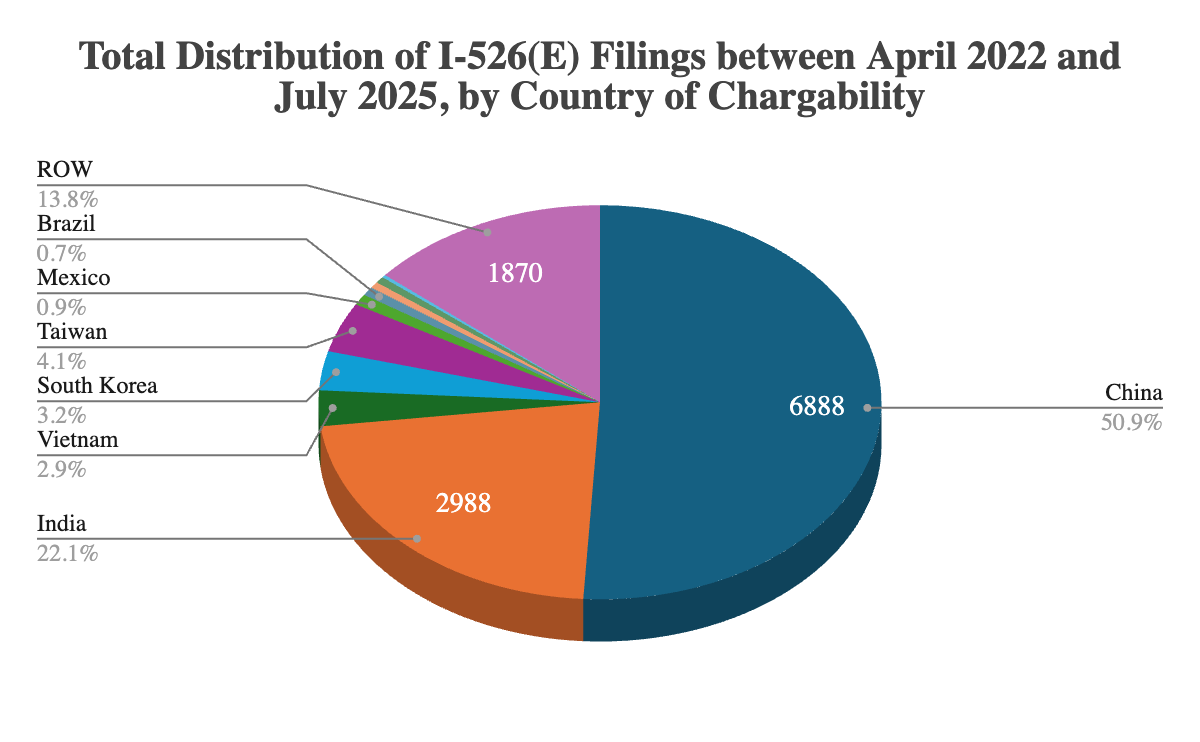
AIIA FOIA Series: Updated I-526E Inventory Statistics for July 2025
AIIA obtained new FOIA data through July 31, 2025 revealing how USCIS is actually processing EB-5 petitions, showing heavy prioritization...
了解更多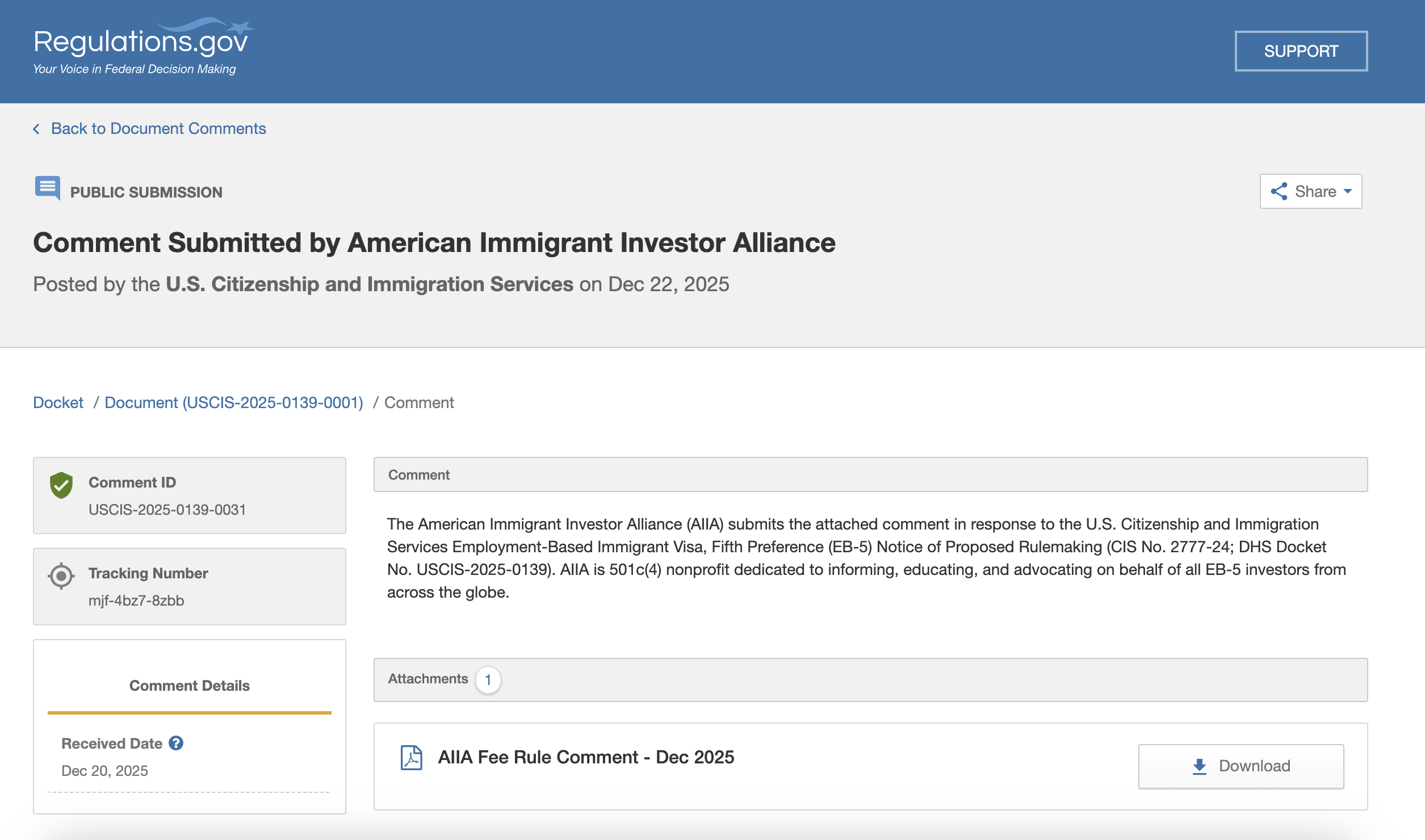
AIIA Submits Comments on USCIS NPRM on Updated EB-5 Fee Rule
AIIA submitted comments on USCIS’s October 2025 EB-5 fee NPRM supporting revised, lawful fee levels but urging refunds for overpaid...
了解更多

联系我们
如果您有任何问题、咨询或合作建议,请随时联系我们。
 Chinese
  English
  Vietnamese
Thank you for the Good work AIIA is doing.
Appreciate all the work that AIIA has been done.