本月,佛罗里达州州长办公室通过了一项禁止 “利益相关国 ”公民投资和购置财产的法律,仇外心理占据了主导地位。该法案的真正含义是以种族主义的方式侵犯主要是在该州生活、工作和投资的中国移民的宪法权利。AIIA 分析了未来在佛罗里达州进行 EB-5 投资的风险,以及对投资者 EB-5 之旅的任何负面影响。.

A new law in Florida, known as Senate Bill 264 “Interest of Foreign Countries” act, has restricted the right to buy and own “real property” in the state of Florida for immigrants from China, Cuba, Venezuela, Syria, Iran, Russia, and North Korea. The most harsh restrictions on ownership (or partial ownership) of land and real estate are targeted towards Chinese nationals, whom Governor Ron DeSantis (R-FL) has put forth as a national security concern through possible connections to the Chinese Communist Party. This law was met with bipartisan support in Florida’s House and Senate, and was signed into law on May 8th.
The bill targets new real estate rentals, purchases, or acquisitions by “foreign countries of concern” taking place after July 1st, when the law comes into effect. Foreign nationals of interest” are defined as non-resident immigrants without lawful permanent residency through an immigrant visa and or green card. Countries of interest include Russia, Iran, North Korea, Cuba, Venezuela, Syria, and most especially, China.
The law prohibits government entities from contracting with or providing economic incentives to any citizen from these “countries of interest”, and similarly, prohibits land ownership (or partial ownership) of agricultural and other real estate located within 10 miles of critical or military infrastructure. These infrastructure sites are located within many of Florida’s large cities, preventing immigrant nationals from moving into places such as Miami, Orlando, Tampa, etc. Furthermore, foreign nationals from China are totally restricted from buying any property across the state of Florida with incredibly narrow exceptions.
The issue AIIA sees with this law, beyond its blatant racism and violation of constitutional rights, is that its language is broad enough to include EB-5 investments, on top of the explicit limitations on property ownership. This law could harm investors with an indirect or direct stake in an EB-5 project, especially those with an equity stake. Equity in a specific construction project (even through a New Commercial Enterprise) could potentially be viewed as “partial ownership” of a real estate asset. The “ownership” aspect may force investors to sell their stake in the project and possibly disqualify their EB-5 petition.
In addition to the prohibition and restrictions on buying real estate, all property owners who fall under the umbrella of “a foreign national of concern” must register their land ownership with the state, under severe penalties such as expensive fines or land forfeiture. Any new property owners will also be required to sign an agreement, under penalty of perjury, that they are not a foreign national, or at least have lawful permanent residency in the U.S.
DeSantis has stated that this bill protects national security by “counteract[ing] the malign influence of the Chinese Communist Party in the state of Florida.” Representative David Borrero (R-105) concurs with this sentiment, fighting against the idea that this bill creates total “Chinese Exclusion Zones” as the ACLU claims. “The only people who this bill discriminates against is the Communist Party of China,” he says.
The influence of the CCP has drawn a litany of attention from lawmakers in recent years, especially within the immigration system. The US Government Accountability Office (GAO) even stated in their latest report on the EB-5 program, “DHS and others have expressed concern that totalitarian parties, such as the Chinese Communist Party, may attempt to exploit the EB-5 program to steal intellectual property and gain influence in American companies.” However, neither Desantis, nor the DHS, has publicly drawn any connections between property ownership in Florida and the influence of the CCP. A bill remarkably similar to FL SB 264 was even proposed earlier this April in Texas, and similar foreign land ownership restrictions have passed in ten other states.
This law is set to take effect starting July 1st, after which all new purchases of property will be restricted for countries of interest, and residents with land ownership will be forced to report their ownership to the state of Florida. This law has already been the source of a lawsuit filed in May by AIIA Member, DeHeng Law Offices PC, alongside a group of Chinese Citizens who live and work in the state of Florida. Their suit, Shen v. Simpson, claims SB 264 violates the Constitution and Fair Housing Act, as well as the Equal Protection and Due Process clauses of the US Constitution.
"(《世界人权宣言》) Shen suit also draws attention to the penalties incurred by Chinese individuals for violations of this new law. The penalties for Chinese individuals acquiring new property illegally can escalate to a third-degree felony punishable by up to five years in prison and up to $5,000 in fines. Sales of properties to Chinese individuals only warrants a $1,000 fine. The suit alleges real estate firms are discouraged from doing business with Chinese immigrants because of the law, which further impacts their residence within the state of Florida. Additionally, the complaint necessarily draws comparisons between SB 264 and the Chinese Exclusion Act and Alien Land Laws passed by the US federal and state governments in the early 1900s, and reminds us of only how recently laws such as this have been repealed (in the state of Florida, as late as 2018). Additionally, the Shen lawsuit points out that Chinese land purchases in Florida only constituted 0.1% of total residential real estate sales in 2022, and less than 2% of real estate purchases by foreign buyers.
On June 6th, DeHeng et. al filed for a preliminary injunction on the Shen lawsuit, asking the court for the law’s implementation to be temporarily blocked until the conclusion of the case.
"(《世界人权宣言》) American Civil Liberties Union joined this lawsuit with DeHeng and has voiced their strong opposition to the law, stating that property registration and restriction of ownership based on ethnicity “will codify and expand housing discrimination against people of Asian descent”. They note that this law promotes racial biases against Chinese nationals as retribution for the actions of the Chinese Communist Party and President Xi Jingping, and strips Chinese immigrants of their financial freedom. The organization states exclusive laws which strip immigrants of their economic rights are prone to stoking racism, reactionary violence, and general xenophobia against members of these groups.
It is unclear whether this law will completely restrict EB-5 investments or if this law will have any effect on the program. It is possible that EB-5 is not impacted by this law, given that investors in the regional center program do not directly invest into a project, but are using a special purpose entity to invest or loan capital into a commercial enterprise. EB-5 is not mentioned by name in the law, but was brought to the attention of lawmakers in Florida’s congressional hearings. Since the law was brought into effect, attorneys, lobbyists, journalists, and consultants have all had different opinions on what the implications of this bill could be.
Miami-based and immigration attorney, Michael Harris, notes that this bill does not specifically mention EB-5 investors, but could still curb real estate development in Florida. Florida has consistently remained a massive hub for EB-5 capital, with 9% of all currently approved regional centers operating in the state and US businesses profiting $4 for every $1 invested in the EB-5 program. Lawmakers themselves have even promoted EB-5 investment in Florida, most notably through the high-tech Sawmill built in Suwannee county in 2011 which was promoted by then-governor, Rick Scott (R-FL). It has yet to be seen how lawmakers will interpret the use of foreign equity or loan investments into EB-5 projects, and whether the separation of a regional center will be sufficient enough to protect EB-5 investors from exclusion.
Harris believes some direct EB-5 investments and equity investments through regional centers could be prohibited entirely. “Foreign investors might be deterred by the potential restrictions and penalties associated with acquiring real property in Florida,” says Harris, “especially because Chinese nationals who are engaging in real estate deals may be required to divest themselves of their property within an unspecified amount of time.”
According to Harris, if ownership is less than 5% in the company owning or buying the property in question, there may be exemptions for Chinese and other foreign nationals. This could mean for large scale EB-5 projects or projects with investments in a Regional Center offering, the investor may be exempted from SB 264. Harris also notes that dual citizens may be exempt from this law as well, such as Chinese citizens with Canadian citizenship, for example. However, he emphasizes more clarity is needed from lawmakers to determine “how the term “foreign principal” is interpreted in practice.”
AIIA will post updates on this blog as we learn more about how this law will be interpreted in practice, and following the progression of the Shen suit. To support our work, please consider 为我们的组织捐款 或 becoming a member of our community. Every dollar donated to AIIA goes towards informing the investor community of issues like this, supporting the legal efforts of EB-5 investors, or towards lobbying the US government for transparency and equity in the EB-5 program. For any questions, comments, or concerns about this article or AIIA’s mission, please use our 联系表 to get in touch with us, or schedule a call with our team to figure out what AIIA can do for your EB-5 process.






了解 AIIA 的最新动态
加入我们的时事通讯,了解 EB-5 的最新动态。.
一旦订阅,即表示您同意我们的隐私政策,并同意接收本公司的更新信息。
推荐资源



最近的博客文章
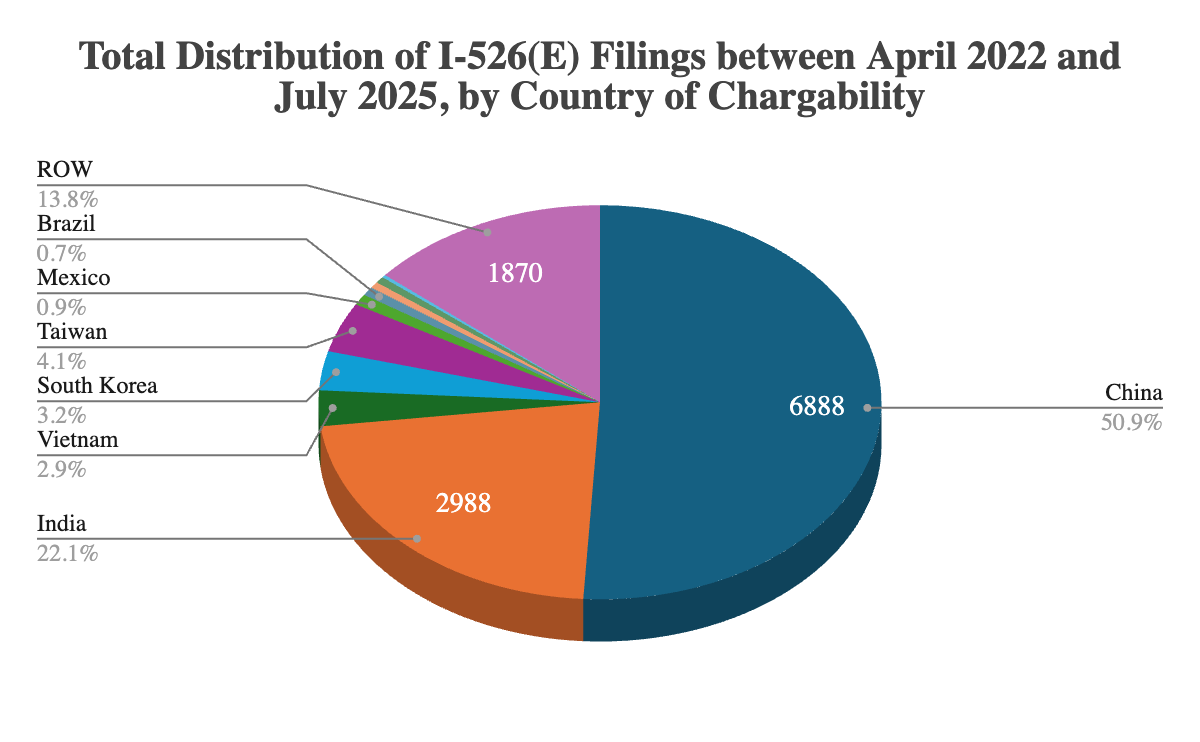
AIIA FOIA Series: Updated I-526E Inventory Statistics for July 2025
AIIA obtained new FOIA data through July 31, 2025 revealing how USCIS is actually processing EB-5 petitions, showing heavy prioritization...
了解更多
AIIA Submits Comments on USCIS NPRM on Updated EB-5 Fee Rule
AIIA submitted comments on USCIS’s October 2025 EB-5 fee NPRM supporting revised, lawful fee levels but urging refunds for overpaid...
了解更多

联系我们
如果您有任何问题、咨询或合作建议,请随时联系我们。
 Chinese
  English
  Vietnamese
答复 (0)